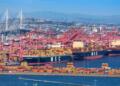
The Port of Long Beach , considered the second most important maritime gateway in the United States, is entering 2025 with a steady but cautious approach. After a record year for container traffic, the port authority observed a moderate slowdown in October, attributed to retailers strategically bringing forward orders and the side effects of volatile trade policies.However, the prevailing narrative at the Californian port is not one of alarm, but rather one of operational resilience and logistical foresight in the face of an uncertain global environment.
During a virtual press conference, CEO Mario Cordero and COO Noel Hacegaba agreed that tariff changes and trade policies among the world’s major economies have created uncertainty, but without halting the flow of goods . “Consumers haven’t seen significant tariff impacts since manufacturers, retailers, and others have shared some of these costs and mitigated price increases for consumers, but that could change as we approach 2026,” Cordero cautioned.
The message carries a warning tone: protectionist measures and adjustments in the global supply chain could, sooner rather than later, pass on some of the costs to the end consumer. “Consumers are likely to see a price increase in the coming months as carriers continue to pass on the cost of tariffs on goods,” the executive added. This observation positions Long Beach not only as a barometer of the American economy, but also as a gauge of the real impact of global trade tensions on consumers’ wallets.
The data reinforces the narrative of cautious stability. In October, the port handled 839,671 twenty-foot equivalent units (TEUs), a 14.9% decrease compared to the same month last year , which remains the highest in Long Beach’s 114-year history. Imports fell 17.6%, exports 11.5%, and empty containers 12.6%. However, the cumulative total for the first 10 months of the year shows a 4.1% increase, with 8.23 million TEUs, indicating that the port’s structural dynamism remains solid, despite cyclical fluctuations.
Chief Operating Officer Noel Hacegaba emphasized the port ‘s responsiveness in the face of recurring disruptions . “Even amid the nation’s longest government shutdown, cargo continues to move smoothly through our port and throughout the nation’s supply chain,” he stated. His words reflect the coordinated strategy that distinguishes the California port complex: “We continue to coordinate closely with all our partners to anticipate and mitigate issues before they arise, in order to keep cargo and our economy moving.”
This philosophy of logistical anticipation has been a constant in Long Beach. Since the pandemic, the port has strengthened its collaboration with terminals, shipping lines, freight forwarders, and railroads to reduce bottlenecks and maintain its reputation as an agile and reliable hub for transpacific trade. Today, with over $300 billion in annual cargo and 2.7 million jobs linked to its operations—691,000 of which are concentrated in Southern California—its role as critical infrastructure for the United States is reaffirmed.
Port Commission Chairman Frank Colonna summarized the collective effort of those who keep this logistical machine running: “Our dedicated workforce and terminal operators are working tirelessly to ensure store shelves are stocked and shoppers can purchase holiday gifts.” He added a message of institutional continuity that reinforces the port’s long-term vision: “We plan to continue providing outstanding customer service and building a sustainable future in the new year.”
Sustainability is not a new concept for Long Beach; it’s a core principle of its management. In 2025, the port celebrates 20 years of environmental leadership, the anniversary of its Green Port Policy, which has drastically reduced emissions and the environmental impact of its operations. For the seventh consecutive year, it was recognized as the “Best Seaport on the West Coast of North America” and the “Best Green Seaport,” accolades that confirm its position as a global leader in the transition to a sustainable port model.
Looking ahead to the next decade, Long Beach is planning $3.2 billion in capital projects focused on increasing capacity, efficiency, and competitiveness, driven by technological and energy innovation. In a global context that combines trade pressures, inflationary challenges, and new environmental demands, the port is positioning itself as a laboratory for maintaining the flow of trade without sacrificing sustainability.
Ultimately, Long Beach’s stability isn’t measured solely in TEUs, but in its ability to adapt. Its port leadership has understood that foresight and cooperation are the new drivers of competitiveness. In an environment where economic cycles and policies can change from month to month, the port’s true asset is its responsiveness. And in that, Long Beach continues to lead the way.
Comment and follow us on X: @GrupoT21