The history of the Mexican port system cannot be understood without the role played by the arrival of ICAVE at the port of Veracruz. On August 25, 1995, with just four hectares and 200 meters of dock, it became the first concession granted under the new Port Law , published a year earlier. This milestone not only paved the way for the modernization of the sector but also placed Mexico on the path to trade liberalization with an infrastructure aligned with international standards.
Thirty years later, the balance sheet reflects the consolidation of Hutchison Ports ICAVE as a leading operator. Its current capacity reaches 1.3 million TEUs (20-foot containers) per year, with 1,050 meters of quay, two berthing positions, and Super Post Panamax cranes, four of them automated. The infrastructure also includes a Logistics Activities Zone (ZAL), a CFS warehouse, connections for refrigerated cargo, and technological systems that incorporate autonomous tractor-trailers, OCR access control, RFID, real-time control, and smart access.
One of the most significant moments in its history was the development of Bahía Norte , the result of an unprecedented joint venture between the port authority and ICAVE. This collaborative model set a precedent for the way port expansion projects are conceived in the country.
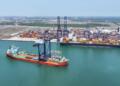
On its thirtieth anniversary, the company reinforced its strategy with a new state-of-the-art electric crane, acquired with an investment of 226 million pesos. It also implemented the Remote Operation System (ROS) on four dock cranes and launched autonomous trucks. This technological commitment responds to Hutchison Ports’ global policy of decarbonization: reducing its absolute emissions by 54.6% by 2033 and achieving net-zero emissions by 2050.
“Our priority is to maintain competitiveness with increasingly cleaner operations. The electrification plan is moving forward with clear goals for 2033 and 2050,” emphasized Jorge Magno Lecona Ruiz, director of Hutchison Ports in Mexico, Latin America, and the Caribbean, as quoted in a press release.
ICAVE’s importance is also evident in social and labor terms: it generates more than 1,500 direct jobs and approximately 13,000 indirect jobs. “ICAVE’s value is reflected in its people. Thirty years later, Veracruz maintains a central role within our network and meets the highest international standards of efficiency and safety,” Lecona Ruiz emphasized.
Operational milestones reinforce this vision: in 2015, it reached 10 million cumulative TEUs; in 2018, it surpassed one million annual TEUs for the first time; and in 2019, it completed its migration to Bahía Norte. By 2026, the goal is to begin Phase II of construction with the goal of serving larger vessels and expanding installed capacity.
Within Hutchison Ports’ national network, ICAVE connects with Manzanillo (TIMSA), Lázaro Cárdenas (LCT), and the TILH intermodal hub in Hidalgo. Its rail connectivity with corridors to Puebla, Mexico City, the Bajío region, and Monterrey strengthens the port of Veracruz’s role as an entry and exit gateway for Asian cargo crossing Mexico via intermodal transport, with significant logistics savings in time and costs.
The 2025-2026 plan includes the addition of new empty container cranes, reach stackers , electrified RTGs, and autonomous tractors. Specialized services such as LCL and refrigerated cargo, inspections, labeling, and digital traceability will also be continued, with registration processes in seconds and security systems that optimize traffic in yards and gates.
Hutchison Ports ICAVE’s agenda goes beyond business. Its social responsibility programs, such as Go Green and Dock School , along with training in safety, productivity, and quality, consolidate a comprehensive operating model with a community impact.
Three decades after its founding, ICAVE maintains a strategic position in the Gulf of Mexico. Its vision for the future combines investment, technology, sustainability, and human capital, factors that explain why it remains a key player in the Hutchison Ports network and on the country’s logistics map.


Comment and follow us on X: @GrupoT21