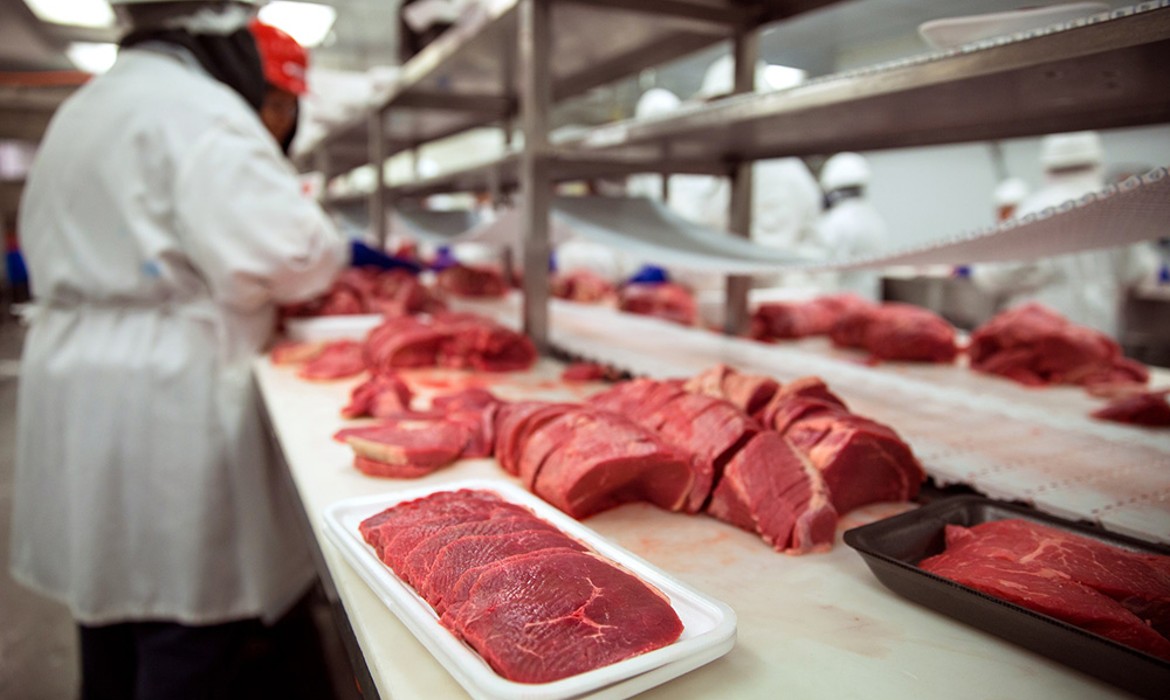
Mexico must strengthen its cold chain to meet the demand for animal protein consumption , which continues to grow and is estimated to reach 470 tons by 2050, opening up opportunities for the meat industry , since all products must be kept refrigerated or frozen .
This was stated by Alonso Fernández Flores, president of the National Association of Federal Inspection Type Establishments (ANETIF) , in the presentation Panorama and projections of the animal protein industry , during the Cold Chain Connection , organized by the Global Cold Chain Alliance (GCCA) .
He added that when discussions are held to open or close markets nationally or globally, the key is to consider whether a good cold chain exists, since a lack of optimal conditions can destroy a company’s reputation and even international trust in a country.
The president of ANETIF considered that in Mexico, the meatpacking industry has a high development potential, since the current capacity is not sufficient nor is it growing at the rate of meat consumption , which is why they are looking for companies committed to certification and with products in a position to be able to export , since the TIF System is the first requirement that must be met in order to sell abroad, for which efficient and auditable cold storages are needed.
Alonso Fernández emphasized that the TIF System currently has 443 establishments, 110 warehouses with other activities, and 110 cold storage facilities , which are insufficient, since there are areas of Mexico with no presence of cold chain companies, mainly in the south and southeast of the country.
He pointed out that there is a gray area or one that is underserved, such as cold transport , which is responsible for transporting the product from the distributor’s plants to the point of export . In light of the doubts and challenges they face, such as road insecurity , a working committee was created to find solutions to this problem.
“It’s a huge challenge, but we’ve been working with sister associations and the National Agricultural Council (CNA) on this issue, and a couple of weeks ago we held a meeting with the Secretary of Public Security and the Undersecretary of Intelligence. We discussed the transportation sector’s concerns, such as road safety, with them. A pilot plan was established through 089 to report these situations and address them,” explained Fernández Flores.
During his presentation, the specialist emphasized the increase in consumption of poultry , pork and beef and exports to 64 countries, with the United States , Japan , South Korea and Canada being the main markets.
“In 2024, there was an increase in animal protein consumption, representing more than 11 million tons of poultry, pork, and beef, placing Mexico as the eighth largest meat producer, the leading supplier of food to the United States, and recording an agricultural surplus of more than seven million dollars,” he emphasized.
For his part, Federico Assaleih Ortiz, president of the Veracruz Agricultural Council, in the presentation “Perspectives on Trade, Resilience and Expansion in the Face of the Global Crisis ,” pointed out that geopolitical conflicts , which are increasing and affecting the movement of goods ; climate change , which is seriously affecting the agricultural sector; the aftermath of the pandemic in terms of inflation and connectivity, since people are not moving around and are no longer going out as before; and changes in consumption and communication habits are causing hunger among the world’s population.
“We are experiencing food insecurity, and it has long been a mission of the United Nations (UN) to try to achieve zero hunger. There is an entire plan that is unfortunately failing because more and more people around the world are experiencing food insecurity,” he asserted.
He added that in the 2024 UN study of the 53 countries at risk of food insecurity , Mexico is among them. This reveals the existence of 295 million people in a food crisis situation , either not having enough food or experiencing a zero-food situation , which was exacerbated by the COVID-19 pandemic .
In 2016, only 11% of the world’s population was at risk of food insecurity, and today it stands at 22%, because the greater the number of people, the more food is needed, and if food production doesn’t grow at the pace needed, food prices will become more expensive.
“Furthermore, we are experiencing one of the three price crises recorded in the last 25 years. The first two were due to oil shortages, the second to energy issues combined with climate change, and this third to the closure of the supply chain, which exacerbates the challenges for marketing products,” noted Federico Assaleih Ortiz.
He considered that although Mexico is the main producer of sugar cane , lemon , avocado , beer , mango , berries , meat and bakery products , 2025 will be the worst year for the production of grains and oilseeds , since 275 thousand hectares will be left without crops for various reasons, mainly due to water shortages , inflation and rising international prices .
Comment and follow us on X: @GrupoT21