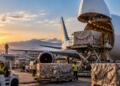
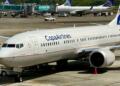
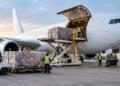
The United States Department of Transportation (DOT) identified that the limitation of slots (takeoff and landing times) at Mexico City International Airport (AICM) and the relocation of dedicated freighters to Felipe Ángeles International Airport (AIFA) allowed the alliance between Delta and Aeroméxico to consolidate its position in passengers and cargo, with the Mexican airline having the largest share of the cross-border freight market .
According to the Supplemental Order of Justification proposing the end of the antitrust immunity (ATI) granted to these airlines in 2016, from 2023 to the present, since the departure of the U.S. cargo airlines, cargo movement at the capital’s airport has decreased by approximately 40%; however, Aeroméxico’s market share has increased by approximately 10% and “continues its upward trend today.”

“Furthermore, by forcing all-cargo carriers to abandon the AICM, Delta/Aeroméxico and other combined carriers are allowed to continue transporting cargo in the hold; Mexico confers an unfair advantage in the cargo market to ATI holders who also hold a disproportionate share of the slots,” he argued.
The DOT noted that the Delta-Aeroméxico alliance now controls the majority of cargo at the AICM , placing the airline in an advantageous position to connect that segment with markets throughout the region.

This situation, the DOT emphasized, is also affecting other airlines that offer cargo in the hold, which are reducing their capacity. American , United Airlines , and Delta are the only ones that transport cargo this way, each with between 9% and 15% of total tons .

“Aeroméxico has an even larger share of cargo volume between the United States and Mexico specifically, transporting 73% of all cargo tons in the hold in 2022-2023 alone,” he explained.
Fabricio Cojuc, aviation consultant and co-founder of the Altitude Aviation Leaders podcast , said Aeromexico’s surge in cargo handling market share is due to its strong presence with scheduled flights and the ability to carry cargo in the belly of its planes .
In that sense, he indicated that the transfer of the cargo ships to AIFA contributed to the alliance capturing a certain volume that other companies stopped moving , which made it stronger than it already was, “the cargo business is registered in the joint venture , it is giving steroids to a heavyweight, who already has very strong muscles.”
The DOT identified that continuing the Delta and Aeroméxico ATI, granted in 2016, no longer guarantees open market access and could potentially harm consumers, the traveling public, competing air carriers, and the economies of both countries. Therefore, it preliminarily concluded that it would terminate the ATI on October 25
In response, Fabricio Cojuc considered that the impact would be felt in passenger and cargo volumes, “I don’t think it will be dramatic. They will continue to have an alliance of commercial partners, shared codes , they work together in aircraft maintenance, air cargo, there is very deep cooperation and, according to the DOT, it is not at risk. What is at risk is the possibility of coming together to decide on certain issues or decisions outside of certain restrictions of competition or monopolistic nature.”
The specialist explained that if there is no more supply at the AICM, both companies will continue to have a strong position in this infrastructure, since they have more than 50% of the slots . Therefore, without antitrust immunity, “their position as a very strong and commercially integrated competitor would be diminished, but not dramatically.”
Currently, the Aeroméxico-Delta alliance operates more than 60 routes between both countries , through more than 90 daily operations, and has transported more than 50 million passengers since 2017.
According to both airlines, the potential cancellation of the Joint Cooperation Agreement (JCA) would have an impact of $800 million . The DOT has provided 14 business days from the date of notification for the companies to submit their respective comments, and they will receive a response from the authority within seven business days.
It should be recalled that the DOT announced on July 19 the measures it will impose on Mexican airlines, due to Mexico’s alleged failure to comply with the Air Transport Agreement signed in 2015. This has included a reduction in operating hours at the AICM and an order to send freighters dedicated to the AIFA, something that, it indicated, has affected U.S. airlines.
Comment and follow us on X: @evandeltoro / @GrupoT21