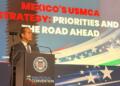
The United States-Mexico-Canada Agreement (USMCA) faces a radically different global context than its origin, where geopolitics and national security are redefining the rules of trade, as announced by business leaders at the 85th National Congress of Customs Agents of the Confederation of Associations of Customs Agents of the Mexican Republic (CAAAREM) .
The USMCA can no longer be analyzed using the logic of the 1990s, explained Emilio Cadena, CEO of Prodensa and Chairman of the US-Mexico Foundation .
“Today, supply chains are not defined by efficiency or sustainability, but by national security. This is not a business issue; it’s a political priority for the United States,” Cadena warned.
Still, he said there is a unique opportunity if the region deploys capital to produce more locally and stop depending on Asia, “thinking like China,” as he defined it.

For his part, Gerald Schwebel, president of North American Strategy for Competitiveness (NASCO) , stated that the value of the USMCA today is higher than ever, due to the high tariffs applied outside the agreement.
“This is extraordinary news for Mexico,” he stressed.
He also urged the private sector not to rely solely on the chambers: “Companies must be at the table, not spectators. Trade isn’t made by governments, it’s made by companies,” Schwebel asserted.
From the logistics front , Sergio Espinosa, commercial manager of Hutchison Ports , explained the bottlenecks facing Mexican foreign trade.
“Only 26% of international cargo moves by sea, despite Mexico’s extensive port network. We must break our dependence on land transport,” he said.
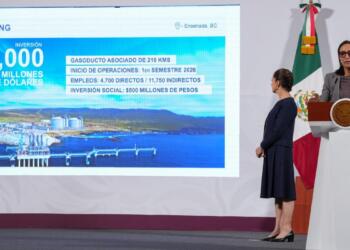
He highlighted that Hutchison Ports has made strategic investments in ports such as Ensenada, Baja California; Manzanillo, Colima; Lázaro Cárdenas, Michoacán; and Veracruz, as well as in an intermodal hub in Hidalgo to strengthen the national logistics network.
Juan Pablo Cervantes, president of the International Section for North America of the Mexican Business Council for Foreign Trade, Investment and Technology (COMCE) , called for the business sector to protect the trilateral trade agreement .
“Mexico is already the largest market for US exports. This interdependence should be used as a strategic argument in the review,” he said.
He called for continued strengthening of value chains, human capital, and the professionalization of foreign trade.
The panel discussion on these topics was moderated by Fernando Con y Ledesma, president of the National Board of Directors of the Mexican Association of Shipping Agents (Amanac) , who highlighted that the review of the USMCA comes at a decisive moment for the region and invited the speakers to reflect on its political and logistical implications.
Comment and follow us on X: @karinaquintero / @GrupoT21