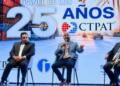
In CTPAT’s 25 years , three generations of professionals linked to international trade and security have come together. In Mexico, each generation of professionals who complete their university studies and enter the workforce encounters a different environment than those who came before them. It’s not just a technological difference: the rules, the markets, the threats, the ways of doing business change, and with them, the paradigms we have considered correct for years.
If we go back two generations, approximately 42 years, we find that generation, we could call the “NAFTA Generation”, formed in Mexico’s transition to an open economy.
Between 1985 and 2005, Mexico transitioned from a protectionist model to one of gradual integration into the international economy . Accession to the GATT, the implementation of NAFTA, the 1994 financial crisis, the national security environment following the EZLN uprising, and, particularly, the events of September 11, 2001, all altered the landscape of international operations.
Trade liberalization increased the need for competitiveness, quality, and logistical efficiency, but it also made it clear that goods, means of transport, and companies could be used for illicit activities.
After 9/11, a new concern emerged: trade not only had to be facilitated, but it also had to be secure. CTPAT was established in 2001 , and a few years later, in 2005, the World Customs Organization adopted the SAFE Framework of Standards to secure and facilitate global trade. This marked the beginning of a new vision: security could no longer be considered solely the responsibility of authorities, but rather a shared responsibility between governments and businesses.
Thus emerged a second generation: the “Globalization and Security Generation .” Between 2005 and 2025, this generation experienced a much deeper transformation of supply chains. Globalization multiplied suppliers, routes, logistics operators, and levels of outsourcing, while threats evolved from traditional smuggling to phenomena such as drug trafficking, human trafficking, forced labor, terrorism, cargo theft, internal conspiracies, and, subsequently, cyberattacks on supply chains.
In Mexico, the period from 2006 to 2012 was also marked by the intensification of the security strategy against organized crime. Violence began to directly impact transportation, logistics, and business continuity. The global financial crisis of 2008–2009 highlighted the interdependence of economies; subsequently, the renegotiation of NAFTA and the entry into force of the USMCA forced a renewed review of supply chains. The COVID-19 pandemic demonstrated that a global supply chain could be disrupted by a cause not necessarily related to crime. And then came nearshoring .
Mexico once again became a strategic player for North America, but now under a different condition: competitiveness no longer depended solely on cost and speed; it began to depend also on resilience, traceability, compliance, and security. During these same years, CTPAT evolved. What was originally perceived as a post-9/11 security initiative gradually became a much broader risk management system for supply chains, incorporating trading partners, transportation, seals, procedures, cybersecurity, personnel security, and awareness.
That’s why I believe the 25th anniversary of CTPAT shouldn’t be seen merely as a celebration of a US program. It’s also evidence of how security has been progressively incorporated into the very fabric of international trade.
And here a third generation emerges. Those who will begin entering the professional world around 2026 will, in my opinion, be the “CTPAT Generation .” This generation will no longer find two separate worlds—trade on one hand and security on the other. They will find a single ecosystem. The international trade we have known for decades is evolving into what I consider a more accurate concept: Trade & Cargo Security.
This isn’t just about changing a term. It’s about acknowledging a reality: security is now intrinsically linked to any logistics operation. Goods that cannot be reliably identified, tracked, protected, and delivered pose a risk to the entire supply chain, regardless of whether the customs process is correct.
The evolution of the WCO’s SAFE Framework itself confirms this trend. Its 2025 version incorporates, among other aspects, greater attention to cooperation between authorities, insider threats, codes of conduct, and the integrity of authorized economic operators. Security is no longer just a control point; it has become a cross-cutting element of the supply chain.
And where is this third generation headed? We cannot predict the future, but we can observe its signs. Current leading forecasting exercises point to a more geopolitically fragmented world, with greater competition for technologies, strategic resources, and supply chains. At the same time, artificial intelligence, cybersecurity, automation, and technological risks are acquiring a significance that just a few years ago seemed reserved for science fiction. The World Economic Forum specifically identifies geoeconomic confrontation, cybersecurity, and the adverse impacts of artificial intelligence among the risks that will shape the next decade.
Therefore, the biggest paradigm shift will likely not be technological, but professional. The new generation will have to learn to simultaneously manage commerce, logistics, information, technology, security, and risk. They will have to understand that a supplier can be a risk, that a person can become an internal threat, that data can be as valuable as merchandise, and that a logistical disruption can quickly escalate into a national security issue.
After 25 years, CTPAT leaves us with a lesson worth acknowledging in Monterrey: supply chain security didn’t come after international trade; it came to be an integral part of it. The first generation opened borders, the second learned to globalize and protect them; the third will have to learn something different: making trade secure from its origin to its destination. That is, perhaps, the true meaning of the next 25 years of CTPAT. And that is the new paradigm of Trade & Cargo Security.
Connect and comment with Victor via LinkedIn .
Comment and follow us on LinkedIn: @GrupoT21