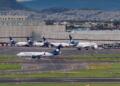
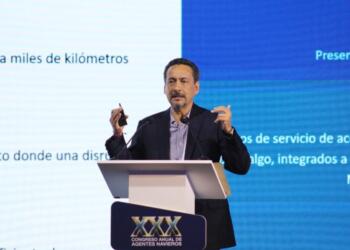
One week after the start of the 2026 FIFA World Cup, the expectation of a greater influx of passengers at the Mexico City International Airport (AICM) has not yet materialized, despite the fact that this infrastructure was the subject of various modernization works, whose total investment will be 10 billion pesos (mdp) .
During a tour conducted by T21 at both terminals of the Mexico City International Airport (AICM), no crowds or significant increase in the presence of domestic or international tourists related to the World Cup were observed. The corridors, check-in areas, waiting rooms, and commercial establishments showed moderate activity, far from the high occupancy that some sectors had anticipated for this time of year.
The situation was also reflected in the two Fan Fest areas set up inside Mexico City International Airport (AICM) to offer passengers the chance to follow the tournament matches while waiting for their flights. Although they had screens for broadcasting the games and areas for socializing, the number of fans was limited . The country’s main airport lacked the usual excitement that accompanies an event of this magnitude.
Admiral Juan José Padilla Olmos, general director of the AICM, told this media outlet that passenger traffic has remained at an average of 115,000 to 120,000 daily users .
“There’s a constant trend, and the day we had the fewest passengers, for natural reasons, was the inauguration day. We handle 125,000 daily. Growth has been very slight; there hasn’t been the increase we expected. Studies projected six million passengers, not all for Mexico City International Airport (AICM), but distributed among Guadalajara, Monterrey, and Cancún. We expected an increase of 400,000 to 500,000 passengers per month starting in May. We have an average of 3.5 or 3.6 million passengers per month, and we thought we would be close to four million. We’ll probably reach that number this month,” he explained.

However, he stressed that the AICM has the capacity to handle a high influx of passengers , since in phase one works were carried out to improve the comfort and experience of the user, as well as the use of new technology, something that had not been done in the last 15 years, among other works that increased the planned budget.
“We started with a project of eight billion five hundred million pesos and with unforeseen events such as collapsed drainage systems, improvements to lightning rod systems, camera equipment, we are now at over 10 billion pesos that will be completed in phase 2, and which will be finished in December 2026,” he specified.
He highlighted that more than 30,000 square meters were recovered, which will structurally benefit the passenger more, complying with the standards of the International Air Transport Association (IATA) .
In turn, Captain Arturo Flores Melgoza, coordinator of the remodeling, indicated that these works were carried out in just over a year with the airport’s own resources .
He detailed that among the actions carried out were the expansion of spaces for taxis, the installation of new surveillance cameras, document validators, scanners and new technology that allows speeding up the crossing of a filter, as well as the renewal of baggage carousels and parking lots.


Similarly, a new internet service was installed for passenger use , in addition to the recovery of spaces, an increase in migration modules, information screens, relocation of businesses, to mention a few.
Padilla Olmos indicated that the entire drainage system still needs updating , a third parking building needs to be built at Terminal 2, the inspection filters need to be renovated, the contact rooms at Terminal 1 need to be expanded, the flow separation system and roadways need to be improved, among other actions that will begin next August.
“Maintenance of the taxiways and aprons has not been neglected; it has been constant and ongoing. There isn’t an opportunity for another runway; we have enough for the 46 slots (takeoff and landing times) we have. We still need to attend to the runways year after year with the maintenance that is done. They aren’t potholes, but there are deformations due to natural subsidence,” he explained.
Regarding the possible construction of Terminal 3, Padilla considered that “it is very risky to give an opinion,” although he mentioned that once the second phase of remodeling is completed, a study on the subject could be carried out through the Federal Civil Aviation Agency (AFAC) and the Mexican Air Navigation Services (Seneam) .
“This is an issue that requires thorough analysis, a meeting of many knowledgeable people, an interdisciplinary committee that understands air traffic, road infrastructure, and where to relocate the infrastructure. Giving an opinion is very risky,” he emphasize.
Comment and follow us on LinkedIn: @Evangelina del Toro / @GrupoT21