The Mexican Business Association (AEM) stated that North American economic integration is a structural process that goes beyond trade uncertainty between Mexico and the United States, and stressed that the best way to face this uncertainty is by working as a team.
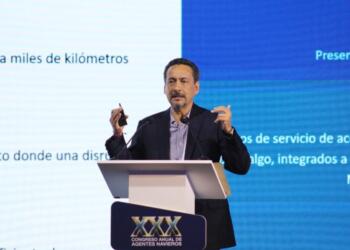
Salomón Sacal, president of the organization’s board of directors, pointed out that ” it’s about teaming up with all sectors of both societies” and emphasized the importance of not limiting Mexico’s competitiveness solely to the export of goods and creating resilient and efficient supply chains .
“Mexico must rise to the occasion. Mexico cannot limit itself to simply selling goods. Mexico must sell supply chain capacity. And what do I mean by this? I mean resilient chains, traceable chains, and complementary, or as they say in English, compliance, because that is what our American partners are looking for,” he stated.
Likewise, in an interview with Grupo T21, he shared that, although there are logistical and regulatory challenges, Mexico enjoys a unique geographical position to consolidate itself as the most relevant trading partner and that it is a structural relationship that no one can escape .
“In the short term, it’s difficult to predict what will happen, because there is this current situation of political rhetoric, fluctuations, and tariffs, but in the medium and long term, the relationship and integration of the United States and Mexico, in the economic sense, is structural. That’s where we’re headed; there’s no way out. Neither Mexico nor the United States can escape it,” he stated.
For his part, Alejandro Castillo, president of the Mexican Association of Entrepreneurs (AEM) in Mexico City, emphasized that the city acts as the main hub for this relationship, attracting a substantial portion of foreign direct investment from the United States . He also highlighted the importance of the capital as a gateway for international corporations seeking to leverage the local infrastructure and talent pool.
Regarding the challenges of the United States-Mexico-Canada Agreement (USMCA), executives expressed cautious optimism about the possible annual reviews and insisted that the trade relationship with the United States should be leveraged.
Furthermore, they reiterated that their fundamental work is to shorten the learning curve for entrepreneurs who wish to expand into the United States, offering a support network that understands the cultural and tax differences. Roberto Castolo, the association’s liaison, shared that success in the U.S. market requires a change in mindset, thinking far beyond politics .
“What would benefit us more than an industrialized United States? Well, we are a supply chain , we are part of it , this is the moment, we have to visualize it, we have to do it. And I sometimes tell many of my clients, ‘ If you were already in Mexico , you would already be selling,’ because you still need to set up, get established, do the work , start producing , and the United States continues to demand our products . In other words, we are in the best possible moment. If we remove this political specter , we will return to a much more competitive position,” he stated.
Finally, the Mexican Business Association (AEM) urged local business leaders to step outside their comfort zones and view the U.S. market as the greatest opportunity for global growth . It emphasized that while Asian investors are coming to Mexico to take advantage of its proximity to the border and do business with the United States, many Mexican entrepreneurs have yet to make that move. Therefore, the AEM’s role is to open communication channels and provide support to those seeking to cross the border with competitive and sustainable projects.
Comment and follow us on LinkedIn: @miroslavacallejas / @GrupoT21