The story of Transportes de Contenedores por Mar (Tecomar) is not just told: it is reconstructed as a foundational piece of modern logistics in Mexico. At the presentation of Carlos Viveros Figueroa ‘s book , the narrative moved between memory, analysis, and recognition of a business venture that, in retrospect, anticipated the transformation of the national port system by at least a decade.
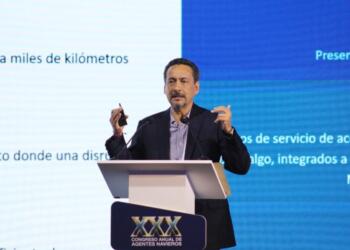
From the start of the book presentation, Luz Alicia Iturbe de Garay, a former official of the Mexican government in positions within the maritime field, set the context that gives dimension to the project: a port of Tuxpan that in the 1970s of the last century had practically no infrastructure , but which, paradoxically, offered a privileged strategic location for foreign trade.
“This project was way ahead of its time, at least 10 years ahead ,” he said, describing how, in an environment without operational conditions, a group of young people – led by Viveros – decided to build not only a company, but a logistics model that did not exist in Mexico.
The presentation’s narrative shifted to the book’s core: the ability to identify opportunities where obstacles prevailed. At this point, Carlos Viveros emerged as the central figure of the story. It wasn’t simply a matter of starting a business in a port without docks or terminals, but rather of articulating a comprehensive vision that combined maritime and land transport with an emerging containerization approach , in a country where these concepts were just beginning to take shape.
Fernando de Mateo, former Permanent Representative of Mexico to the World Trade Organization (WTO) , added another layer of understanding by placing the phenomenon in a global context. He recalled that the true revolution in international trade came not only from trade liberalization but also from logistical innovation: “ The reality was the humble shipping container … that’s what globalization did,” he noted, explaining how the standardization of transportation allowed for structural reductions in time and costs. Within this framework, Tecomar’s strategy was not isolated but aligned with—and to some extent, ahead of—a trend that would redefine global trade.
But it is in Viveros’ own voice that the story acquires its greatest depth. His testimony reveals that the biggest challenge was not technical, but institutional. “It was a real mess, and we pulled it off,” he summarized, referring to the negotiations to build a private terminal in a port where “there was no dock, nothing.” The phrase encapsulates years of navigating a rigid bureaucratic structure, where every step forward involved overcoming resistance and lengthy delays.
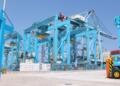
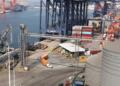
That process, however, resulted in a tangible transformation. Viveros recalled how, years later, upon seeing the port of Tuxpan in operation, he grasped the magnitude of the change: from a space without infrastructure to a thriving logistics hub . “It was achieved through a series of bureaucratic obstacles that had to be fought and overcome,” he stated, emphasizing that port development was not linear, but rather the result of constant persistence in the face of an adverse environment.
The book also documents the operational milestones that marked this process. One of the most emblematic was the arrival of the first containers at the port of Tuxpan and their overland transport to Puebla, an operation that might seem routine today, but which at the time represented a logistical breakthrough. That maneuver encapsulated what would later be conceptualized as multimodal transport, long before its formalization in international agreements.
The results of that vision were soon reflected in the figures. “Tecomar made Tuxpan the second largest port in container handling in 1989 and 1990 ,” Viveros highlighted, while also recalling another key achievement: the consolidation of a shipping company that came to control 40% of the traffic between Mexico and Europe.
Beyond the numbers, the presentation made it clear that Tecomar is not just the story of a company, but of a paradigm shift . The work articulates how the combination of entrepreneurial vision, logistical innovation, and persistence in the face of bureaucracy laid the foundations that are now a structural part of Mexican foreign trade.
In this sense, the book functions both as a testament and a warning: profound transformations in the sector don’t arise from ideal conditions, but from the ability to anticipate them. And in this interpretation, Carlos Viveros’s story ceases to be merely a memoir and becomes an essential reference point for how the ports of the future are—literally—built.
Comment and follow us on LinkedIn: @Enrique Duarte Rionda / @GrupoT21