In the port of Manzanillo, where operational efficiency coexists with latent risks that rarely surface until an incident occurs, security has ceased to be an aspirational concept and has become a breaking point among the various stakeholders in the logistics community. The recent initiative by the Manzanillo Terminals and Operators Association (ASTOM) to implement a Terminal Security Course has not only sparked controversy over its potential cost, but has also revealed a deeper tension: who should assume the responsibility—and the cost—of professionalizing operations within one of the most critical hubs of Mexican foreign trade?
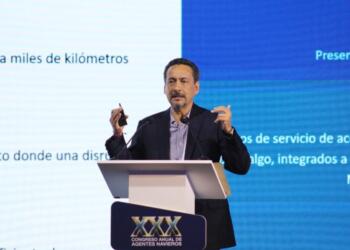
Behind the controversy, however, lies a less visible and more structural story. Juan Carlos Salas, head of the ASTOM Training Center , indicated in an interview with T21 that the project did not arise as an isolated measure, but as part of a process that began with the very formation of the association just three years ago, in a port that, paradoxically, lacked an organization to coordinate its terminals despite its national importance.
In this context, ASTOM was founded in May 2023 and is comprised of Contecon Manzanillo , SSA Marine México , Grupo Hazesa , TAP Terminal Portuaria , and Corporación Multimodal , consolidating for the first time a common voice among the port’s main operators (the only terminal that is not a member is Hutchison Ports TIMSA ). From there, the discussion shifted to the realm of human capital. “There is high demand and low supply of qualified people who understand ports ,” he explained, elaborating that traditional training “trains you for life, not for the port.”
This diagnosis led to the creation of the ASTOM Training Center, conceived as a platform to close specific gaps in the port environment. Under this logic, security emerged as the primary strategic focus , not only due to its operational nature but also because of its mandatory inclusion in concession agreements and the operating rules governing terminals. “Security is a non-negotiable value,” Salas stated, explaining that the course aims to ensure that anyone entering an ASTOM member terminal understands the minimum risks and protocols.
The problem is that, in practice, security is not uniform. Each terminal operated under its own criteria, creating a patchwork of protocols that complicated operations for carriers, customs brokers, and other frequent users. ASTOM’s goal was precisely to unify this standard. “If you went to one terminal, you had one protocol, and if you went to another, a different one. What we’re trying to do is align the criteria ,” he explained.
It was at this point that the initiative clashed with the reality of the port ecosystem. The initial announcement of a paid online course— proposed at 700 pesos— immediately sparked resistance from users, who interpreted the measure as a new charge in a chain already saturated with costs and delays. The reaction was significant: public questioning, pressure from associations, primarily those of transport companies, and a narrative that quickly framed the issue as an attempt by the terminals to monetize their operations.
Salas acknowledges that this moment marked a turning point. “When you say it costs 700 pesos, everyone says, ‘Why are they charging for it?’” he recounted, while defending the logic behind the original approach: “When something is free, people don’t value it.” However, faced with pressure, ASTOM adjusted the model to a hybrid approach: maintaining the paid online option, but opening a free in-person option to avoid excluding any users. In this latter case, the course consists of seven modules with 48 submodules distributed over five days, with three-hour sessions each day.
However, the debate was also influenced by the port authority’s stance. The National Port System Administration (Asipona) Manzanillo issued a statement on February 19 clarifying that it is not requiring any security course at the terminals as a mandatory condition for entry to the port area, thus establishing a key distinction between port access regulations and the internal measures that each terminal may implement.
The discussion, however, did not subside. On the contrary, it evolved into broader questions about the mandatory nature of the course . And it is here that the project reveals its most sensitive aspect: this is not optional training, but a requirement that could condition access to the terminals. “The course is mandatory… if you don’t have it, you won’t be able to enter,” Salas warned, explaining that the terminals are authorized to establish security measures as a condition of access, according to their specific concession agreement and even through port operating rules.
This point, far from being minor, redefines the port’s operational balance. In an environment where the flow of people—from heavy equipment operators to customs brokers—is constant, making training an access filter means shifting security from a reactive to a preventative approach. “Today we focus on correcting: if you violate a rule, I suspend you. What we want is prevention,” he noted .
ASTOM’s most recent decision—to offer the online course free of charge for three months—appears to respond not only to media pressure but also to the need to legitimize the initiative within the port community. The message is clear: the problem isn’t the cost, but rather its adoption. However, even with the temporary free access, resistance persists that goes beyond financial considerations . Some stakeholders have questioned the mandatory nature of the course itself, highlighting a recurring paradox in the sector: the importance of safety is acknowledged, but its institutionalization is resisted.
Ultimately, the controversy also exposes a structural deficiency. As Salas pointed out, most training programs in the logistics ecosystem focus on commercial issues —Incoterms, tariffs, costs —while security remains neglected. “No association offers a security course,” he emphasized, in a criticism that directly addresses the sector’s priorities.
The ASTOM case, then, transcends the discussion of a single course. What’s at stake is how the port of Manzanillo—and by extension, the Mexican port system—decides to manage its risks in a context of increasing operational pressure. Because while the public debate has focused on the 700 pesos that will no longer be charged (over a three-month period), the fundamental conversation remains unresolved: how to build a safety culture in an environment where operational urgency often takes precedence over prevention.
The answer won’t be immediate . ASTOM is still evaluating whether to extend deadlines, apply gradual warnings, or implement outright bans for those who don’t meet the requirement. But what is already clear is that any attempt to raise operating standards in Manzanillo will have to overcome not only technical challenges but also deeply rooted cultural resistance.
And in that area, security—like competitiveness—is not decreed: it is negotiated, explained, and, above all, built .
Comment and follow us on LinkedIn: @Enrique Duarte Rionda / @GrupoT21