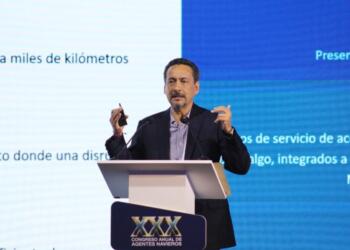
GUADALAJARA, JALISCO – For years, some in the trucking industry believed that European tractor-trailers would struggle to gain traction amidst the inertia of Mexican highways. Alejandro Mondragón, president and CEO of Scania Mexico, recalled this sentiment amid anecdotes and reflections, suggesting it was too risky to change the course of a fleet and opt for a different configuration in a market accustomed to following the same path .
Seven years later, that decision, which many considered too risky, ended up becoming a fleet of 500 trucks traveling Mexican highways . What began amidst doubts about European tractor-trailers, incredulous comments, and resistance within the industry itself, is now moving forward with 132 new trucks (32 R420 units and 100 R460 units) incorporated into the Autotransportes Pilot operation .


All of this is happening at one of the most challenging times for the industry. According to the Mexican Association of Automotive Distributors (AMDA) , between January and April 2026, retail sales of heavy vehicles fell by 28.88% compared to the same period in 2025, while the cargo segment declined by 28.34% and tractor-trailers by 30.27%, reflecting an environment where sustaining investments and renewing fleets has become increasingly difficult. Even so, Scania and Pilot continue to focus on the growth of their operations and the incorporation of new technologies.
In Guadalajara, Jalisco, the delivery of the 500th unit was a reunion of those who have shared the road for years. Amid hugs, jokes, reminiscing, and references to the crises they faced together, executives and employees from both companies spoke of long nights in workshops, operators learning different technologies, and technical teams solving problems on the fly to sustain an operation that grew practically against the current.
“500 units is no small feat. We don’t get here by chance, we get here by choice,” Mondragón said.
He recalled that when the automaker resumed its commitment to the cargo segment in Mexico, there was still doubt that European tractor-trailers wouldn’t find a place in the national market. But seven years later, the story took a different turn.
What began as a disruptive venture ended up building one of Scania’s strongest business relationships in the country. An alliance that grew in volume, infrastructure, maintenance, technical support, and technologies focused on safety and operational efficiency.
But behind the number 500, the executives insisted, what is truly important is not the numbers.
“500 is a great responsibility,” said Roberto García, founding partner of Autotransportes Pilot.
He explained that behind every tractor-trailer there is much more than just a moving asset. There are drivers spending entire days on the road, workshops working through the night, routes that must be followed, and entire supply chains depending on a single unit arriving on time.
“It doesn’t impact one truck. It doesn’t impact two companies. It impacts a product not arriving, a supermarket not being stocked, or a production line failing,” he commented.
In a context marked by road insecurity , operational pressure and greater demands on fleets, Pilot assured that safety remains one of the most important pillars of its strategy.
Arturo Sánchez, founding partner of Autotransportes Pilot , recalled that from the beginning they were looking for an ally that not only offered units, but also technical support, training and technologies capable of protecting the operator on the road.
“Pilot, now more than ever, is still Scania and we are going strong with Scania and we will continue to invest alongside the brand,” he stated.
Part of that strategy operates through the Customer Workshop Service (CWS) model , with specialized Scania personnel working within Pilot’s facilities to streamline maintenance, strengthen operational planning and increase unit availability.
Technology thus became another pillar of this relationship. Roberto García pointed out that the new units integrate systems focused on strengthening road safety , reducing risks on the highway, and providing greater protection for operators.
In parallel, both companies maintain a long-term vision focused on sustainability . Pilot confirmed that it is working on a project to develop a fleet with lower emissions using technologies such as natural gas, a strategy that is part of its plans for the coming years.
What seven years ago seemed like just a test now points towards a new goal.
The celebration of the 500th unit ended up becoming something more profound than a truck delivery. It was, in reality, a snapshot of everything that happens behind the scenes of an operation that rarely stops: the people, the difficult decisions, the early mornings, the miles, and the trust needed to keep moving forward despite any challenges.
Comment and follow us on LinkedIn: @Karina Quintero / @GrupoT21