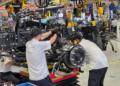
While the Mexican heavy vehicle market registered a 45.5% growth in wholesale sales during June and an accumulated advance of 3.1% in the first half of 2026 (1H26), Scania Mexico assured that it will maintain its investment strategy in infrastructure and after-sales to support fleet renewal and prepare for the next growth cycle of the sector.
Although the economy kept the heavy vehicle market under pressure during the first half of 2026, and the sector expects to close the year with volumes similar to those of 2025, the company decided to maintain its expansion plan. Some indicators in the United States show signs of recovery that could eventually be reflected in Mexico, noted Jorge Navarro, Commercial Director of Trucks and Buses at Scania Mexico .

In that context, the executive stated that the company has not stopped its investments and continues to strengthen its service network to be prepared when the market regains greater dynamism.
“We continue to grow in branches, we continue to expand bays, and we continue to prepare for the future that is coming. This is a very cyclical industry,” he emphasized.
As part of that strategy, Scania is building a new branch in Mérida of approximately five thousand square meters and 10 service bays , which will replace the current facilities and allow a significant increase in service capacity in the region.
For his part, David Hernández, national manager of Corporate Accounts and Used Vehicles at Scania Mexico, indicated that the macroeconomic environment has made fleet renewal more relevant for transport companies.

In that context, he explained that the brand promotes trade-in schemes , through which it receives used units as part of the acquisition of new vehicles to facilitate the modernization of fleets.
Regarding after-sales service , Hernández added that the new facility in Mérida will triple the installed capacity of the current branch, which today serves an estimated fleet of between 300 and 400 trucks and buses on the peninsula.
The commitment to expanding its infrastructure is also supported by the brand’s continued performance in the Mexican market.
According to figures from the National Association of Bus, Truck, and Tractor-Trailer Manufacturers (ANPACT) , Scania sold 122 tractor-trailer trucks wholesale in June, representing an 8.1% market share in that segment. Furthermore, it maintains its leadership in the intercity bus market, with 316 units sold during the first half of the year, equivalent to a 50.1% market share.
With this, the Swedish brand seeks to strengthen its customer service capabilities and support its clients during the fleet renewal process, while preparing its service network to respond to a potential market recovery.
Comment and follow us on LinkedIn: @Karina Quintero / @GrupoT21