The main challenge facing Mexican ports today is not only to strengthen security controls, but also to prevent over-regulation from eroding the country’s operational efficiency and logistical competitiveness compared to other international markets.
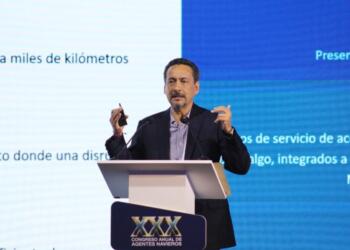
For Luz Alicia Iturbe de Garay, Legal Advisor of the Integral Port Administration (API) of Tamaulipas , the lack of legal certainty has become one of the biggest obstacles to attracting investment to the port sector, even when there are infrastructure projects with high strategic potential.
“The uncertainty surrounding the direction our country is taking is generating this lack of confidence,” he stated during the conference “ Current Situation of the National Port System: Where We Are and Where We Should Be Going ,” organized by the Mexican College of Civil Engineers (CICM) . He recalled that the original spirit of the Ports Law was precisely to offer legal certainty to investors through Master Port Development Programs with a long-term vision of up to 30 years, considering the level of capital required to develop specialized terminals and acquire high-tech port equipment.
“All of this has meant that the operation and maneuvering of the port operation is done in the shortest possible time, and that puts the country’s ports in a competitive status,” he said.
In that context, he explained that currently the regulatory and technical supervision processes have become stricter, incorporating verifications that did not previously exist and that today slow down procedures and authorizations for infrastructure development.

He added that this is compounded by the delay in granting federal maritime-terrestrial zone concessions by the Ministry of Environment and Natural Resources (Semarnat) , with files accumulating for up to six years awaiting resolution.
“We have procedures that have been pending for six years or more, and that stops investment, or, as has happened, prevents the construction of the dock and leads to the saying ‘it’s better to ask for forgiveness than permission’,” he warned.
The specialist also pointed out that the change of control of the port sector from the then Ministry of Communications and Transportation — now the Ministry of Infrastructure, Communications and Transportation — to the Ministry of the Navy significantly changed the relationship with investors and transformed the regulatory processes.
“Previously, the relationship with investors was fostered because that is the job of a port administrator: to seek investment for their port . It is a company that is looking for investors, not driving them away. Sometimes being so strict in their military training distances us from the commercial aspect,” he commented.
In that sense, he considered that the current challenge of the Mexican port system is not only technical or legal, but also one of institutional integration , and therefore called for strengthening the coordination between authorities and specialized organizations in infrastructure, engineering and regulations.
The view was shared by Jesús Campos López, president of the XVI Board of Directors of the CICM, who maintained that the transfer of the port sector marked a turning point in the maritime-port governance of the country, by modifying regulatory processes, technical supervision schemes, priorities and authorization times for projects.
“Today we face other challenges, such as how to balance control and competitiveness , how to provide legal certainty to investors without sacrificing the State’s authority, and how to modernize our ports to respond to the demands and reorganization of global trade,” he explained.
Campos López added that, in addition to the regulatory component, structural challenges related to civil engineering persist, including dredging to maintain great depths , the expansion of docks and yards, last-mile rail and road connectivity, as well as the resilience of the infrastructure to climate change and extreme weather events.
“These are challenges that cannot be solved with a single discipline or a single institution,” he concluded.
Comment and follow us on LinkedIn: @Evangelina del Toro / @GrupoT21