Shipping companies Maersk and Hapag-Lloyd have filed a direct complaint with Mexican customs authorities—specifically the Lázaro Cárdenas port customs office—demanding greater efficiency in transshipment container inspections , given the increased dwell times that are already causing operational inefficiencies and risks to the continuity of their projects and services.
During the 14th Lázaro Cárdenas Port Community Business Meeting , Lidia Linares, Operations Manager for Maersk in Mexico, raised a concern that, she warned, has become widespread across the entire shipping industry operating in the Michoacán port, the second most important for container handling on the Mexican Pacific coast. “Not only Maersk, but all the shipping lines that operate there have had some complicated situations regarding cargo inspections by customs (…) what worries us is the lack of close or structured coordination and communication,” she stated.

The director clarified that the issue is not the authority’s power to inspect cargo , but rather the lack of predictability and certainty regarding the timelines. “No one is saying there shouldn’t be inspections (…) but we are concerned about cargo being held up for extended periods during inspection,” she stated, while emphasizing that the limited feedback—in an environment involving multiple authorities, including the Mexican Navy —ultimately complicates operational management.
In a subsequent interview with specialized media, Linares put the impact into concrete figures: currently, Maersk is facing an average of 300 transshipment containers held up for inspection in Lázaro Cárdenas, with no indication of when they will be released. “They aren’t being loaded (onto the ships) because they are still being held up,” he explained.
The effect on the logistics chain is immediate. Linares explained that each container can remain at the terminal for up to 15 days , well above a healthy operating standard of eight days—with seven days of free storage according to Mexican law—resulting in lost maritime connections and additional costs. “Ultimately, you lose the transshipment, and after 15 days, storage fees begin, and this impacts the customer,” he emphasized, stressing the need for greater traceability and clarity in the processes.
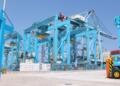
This observation carries greater weight in a context where transshipment already represents 51% of the port’s operations—an activity that has shown a growing trend in recent years—and is a central part of Maersk’s growth strategy in Mexico. The company is evaluating increasing these operations in Lázaro Cárdenas, leveraging the expansion of the APM Terminals terminal (part of the Maersk Group) and the port’s potential as a regional hub , with connections to the US East Coast—via routes using the Panama Canal—as well as to Central and South America. However, Linares cautioned that this development depends on efficiency throughout the entire supply chain.

On that same front, the executive highlighted the importance of the Gemini alliance with Hapag-Lloyd—the world’s fifth-largest shipping company—designed to offer high levels of schedule reliability. “We’re at over 80% and almost 90% schedule reliability ,” she stated, although she acknowledged that this operational precision is compromised when containers are held up without certainty regarding inspection times.
From the same perspective, Roberto Morales, senior cargo operations manager at Hapag-Lloyd, supported the diagnosis and expanded on the scope of the problem . “It doesn’t just affect one shipping line; it affects all the shipping lines that dock in Lázaro Cárdenas. It’s the high volume of containers that customs is inspecting,” he stated.

Morales insisted that the industry does not object to the inspections themselves, but it does question their execution. “They could inspect 100% of the containers, if they had the capacity, but in a very efficient system,” he pointed out. The reality, however, is far from that scenario: “We have a lot of cargo that sits idle for 10, 20, 30 days , and that doesn’t exactly speak to an efficient system in a Mexican port.”
In response to these concerns, Heliodoro Álvarez, general director of the Lázaro Cárdenas National Port System Administration (Asipona) , who was also present at the business meeting, acknowledged that it is a persistent problem, although he noted that it is addressed through the port’s various operational committees . “All the issues and problems that arise are brought to the table,” he stated, adding that customs authorities also participate in these meetings (the same authorities that did not participate in the Lázaro Cárdenas port community event held the previous day in Mexico City).

The official emphasized that customs operates under independent federal guidelines, which limits local agency’s room for maneuver. However, he assured that they are following up on cases reported by shipping companies and agents to “unblock and expedite the process ,” although he admitted that “it has been complicated” and that progress has been gradual.
Álvarez added that, at the federal level, efforts are underway to strengthen customs operations—including plans to extend the operating hours of the Lázaro Cárdenas customs office to closer to 24 hours —as well as infrastructure investments to expand inspection lanes at the port. “I know the problem is ongoing, but we haven’t given up,” he stated.
However, the contrast between the pace of institutional solutions and the operational urgency of shipping companies reveals a structural tension: while the port of Lázaro Cárdenas is accelerating investments to consolidate itself as a regional logistics hub , the efficiency of its customs link continues to lag behind the demands of global trade. At this critical juncture—where infrastructure, regulation, and execution converge—not only is the fluidity of transshipments at stake, but also the port’s credibility as a competitive platform compared to other Pacific nodes .
Comment and follow us on LinkedIn: @Enrique Duarte Rionda / @GrupoT2