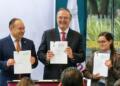
In 2025, the Ministry of Economy, through the Planning and Evaluation Unit, launched Ruta Logística, a professionalization scheme for the logistics sector, which promotes talent development and encourages collaboration between industry, academia, and government.
In its inaugural year, Ruta Logística attracted more than 10,000 logistics and supply chain professionals , and for this 2026 edition, this initiative has been strengthened with more than 33,000 registrations , which demonstrate the sector’s interest in continuing to promote professionalization, said Carlos Candelaria, head of the Prospective, Planning and Evaluation Unit.
Ruta Logística is an initiative that is immersed in the Management Committee for Competencies for Logistics and Supply Chain , where it is contemplated not only the realization of the Ruta Logística webinars that begin on May 6 and end on June 10.

Ignacio Aguado, Director General of Innovation, Services, and Foreign Trade, reiterated that Ruta Logística is a free, online training program with academic credit. “This time, the focus of the six modules is foreign trade, because that’s what they requested.”
Aguado highlighted that the logistics industry maintains a growth of between 7% and 8%, so this dynamic must be addressed, which has challenges such as infrastructure development, but now the development of capabilities is being addressed.
Ruta Logística is constantly evolving, and therefore, it will address the concerns and needs related to topics such as e-commerce , commented Alexandra Patrón, Director of Logistics and Supply Chain at the Ministry of Economy.

In addition to the Logistics Route initiative, the “First National Logistics Route Forum” is planned , which aims to bring together logistics and supply chain stakeholders to strengthen the sector. This event is scheduled for the second half of the year, after the FIFA World Cup, some matches of which will be played in Mexico.
In addition to the Logistics Route and the aforementioned event, the work of the Skills Committee includes the Certification of Labor Competencies , which has resulted in tripling the certification offer for the logistics and supply chain sector; in 2025, six certifications were achieved; in addition, two more are in legal process within Conocer .
The fourth point being addressed is Microcredentials. By 2026, it is planned that these will be awarded in areas such as: Inventory Management, Route Optimization, Supply Chain Planning, Tariff Classification, Operation of Foreign Trade Promotion Programs, Logistics Risk Management, Reverse Logistics, and AI in the Supply Chain, among others. This initiative is being carried out in collaboration with the National Center for Higher Education Evaluation (Ceneval).
The presentation event for this Logistics Route program was attended by more than 20 organizations from the logistics sector , although the initiative has more than 50 partners.


Eva Muñoz Pineda, president of the Mexican Association of Freight Forwarders (Amacarga), highlighted that Ruta Logística is a favorable space for strengthening logistical capabilities.
Leonardo Gómez, president of the National Association of Private Transportation (ANTP), emphasized the space for sharing best practices, promoting shared knowledge, and achieving greater professionalization, in the context of the logistical challenge that the country has, where in Mexico logistics spending represents 12% of the Gross Domestic Product (GDP) , while in countries of the region such as the United States the level is at eight percent.
In matters of foreign trade, the challenge is to redefine responsibilities to create a harmonious foreign trade system, “we don’t know how long it will last as an engine of the economy and we must take advantage of it,” said Javier de Jesús Lagunes, president of the National Association of Importers and Exporters of the Mexican Republic (ANIERM).
Logistics Route training is fundamental in updating the data of new generations, reinforcing knowledge and broadening horizons. “We must open a wide spectrum to make an achievable effort towards the sustainability of SMEs,” commented Karina Lerma, a member of the board of directors of Amacarga.
Comment and follow us on LinkedIn: @Didier Ramírez Torres / @GrupoT21