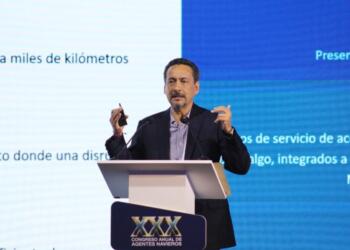
Consolidating Mexico as a logistics and foreign trade platform requires more than just growth in flows and volumes: it demands sufficient infrastructure, streamlined processes, and close coordination between the public and private sectors. This was the central consensus of the panel “Perspectives on the Development and Growth of Foreign Trade, Consolidation of Logistics at the National and International Levels ,” held at the ANERPV Forum , where federal officials and business representatives met.
In the context of the 23rd anniversary of the National Association of Vehicle Tracking and Protection Companies (ANERPV) , the panel members concluded that logistics cannot be understood only as an operational function, but as a strategic enabler of economic development .
This involves challenges and obstacles in the areas of security, digitalization, talent, multimodal infrastructure, and regulations that facilitate the transit of goods, which have been configured as the pillars on which the country’s logistical competitiveness must be built , both for the domestic market and for its integration into global value chains.
Gerardo Tajonar, vice president of the National Chamber of Commerce, Services and Tourism of Mexico City (Canaco CDMX) , emphasized that international trade operates in a high-risk environment facing maritime route closures and geopolitical conflicts, which has motivated the reconfiguration of supply chains.
As a result of the above, coordination between the government and private sector participants is required to address these disruptions that are due to exogenous factors , and the members of the supply chain must manage them.
José Carlos Gilibert, Vice President of Security for the National Chamber of Freight Transportation (Canacar) , stressed that insecurity on the highways continues to be a profound problem , which translates into the killing of drivers.
Regarding infrastructure, Gilibert Peña warned about the lack of infrastructure, which is manifested in the saturation of toll booths due to a lack of technology that would make them more efficient, but also because the options for highways and roads have not kept pace with the operating conditions of road transport .
“Due to insecurity, transporters must stop traveling at certain times, which means we have to travel during daylight hours, coinciding with private vehicles,” added José Gilibert, who also asserted that technological issues such as tracking, telemetry and artificial intelligence are no longer optional, but structural.
Paulino Herrera Manzano, executive director of Supervision at the General Directorate of Federal Motor Transport (DGAF) , stated that progress has been made in self-regulation projects that will allow companies to register operators, units, and cargo for real-time monitoring .
These processes require intensive use of digitization and administrative simplification to reduce times in permits, licenses and authorizations , despite the fact that in previous months the lack of plates for motor transport was denounced, and a circular was even issued to be able to deliver them in printed form, while the metal plates arrived.
From the perspective of Ignacio Aguado, Director General of Innovation, Services and Foreign Trade at the Ministry of Economy , he described that there is a reality where some sectors are export-intensive, while domestic consumption has a high import rate.
Given this situation, Aguado emphasized the importance of logistics, a cross-cutting sector that connects industry, commerce, and infrastructure. To strengthen it, actions have been taken to bolster human capital through certifications and competency standards for the logistics sector, in response to an estimated 25%–30% labor shortage in the industry, with the shortage of truck drivers exceeding 90,000 positions.
Comment and follow us on LinkedIn: @Didier Ramírez Torres / @GrupoT21