



Operating an intermodal terminal involves complex coordination from the arrival of the train to the departure of the containers. One of the challenges is balancing imports and exports. When a terminal receives more imports than exports, empty railcars and equipment begin to accumulate, taking up space and impacting operational capacity.
Conversely, when exports predominate, there may be a shortage of equipment to meet demand, generating delays and additional costs.
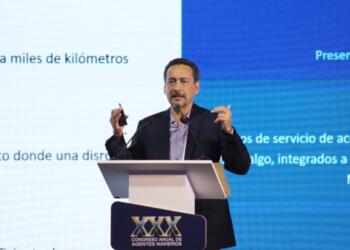
Miguel Durán, senior superintendent of Intermodal & Automotive Ops Mexico at Canadian Pacific Kansas City (CPKC), said that to maintain an efficient flow of containers, decisions must be made about which units to unload first, depending on operational priorities , customer needs, customs times, and logistical requirements, since otherwise every minute lost translates into higher costs and impacts on the entire supply chain.
“What happens if a terminal imports more than it exports? Imagine we receive three trains of 240 containers each, 720 containers in total. What will happen to those platforms that arrived by train if we don’t have any export cargo? Where do we put them? We need to free up the empty railcars so they can be stored elsewhere because we don’t have any exports, and that makes us inefficient,” he explained.
However, he also commented that there are terminals with more exports, where one problem is not having enough equipment to handle them, impacting capacity and transit times.
“Having a balance is complicated because we depend on several factors: that the client loads their products quickly in the warehouse, that the customs agent promptly clears the goods, and having the equipment, but it must be realistic with the demand,” he said during his participation in the panel “The terminal from within: Operation, coordination and container movement” during Container Week organized by the Mexican Intermodal Transport Association (AMTI) .
He also mentioned that safety plays a central role. Operators face risks during physical inspections and container openings, as there may be improperly secured goods or even structural damage that poses a danger to personnel. Therefore, strict protocols are in place at all stages of the operation.
During the process, operators must inspect seals, visible damage, spills, and potential risks associated with the cargo, regardless of whether it arrives apparently in good condition.
In addition to efficient asset management, including chassis, locomotives, cranes, and platforms, maintaining idle equipment represents significant costs for companies and reduces the productivity of the logistics network.
He also said that the operation is exposed to multiple external factors , including weather conditions, mechanical failures, fuel availability, crew shortages, infrastructure overload, computer system problems, and regulatory changes. Any of these elements can affect the normal flow of goods.
In this regard, Durán explained that a terminal can be highly productive and efficient, but if it fails in security, the entire operation loses value.
Comment and follow us on LinkedIn: @Evangelina del Toro / @GrupoT21