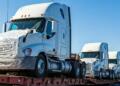
The heavy vehicle industry in Mexico began to show signs of recovery in April 2016, after more than a year marked by declining sales and market volatility. Production and exports registered double-digit increases, while the National Association of Bus, Truck, and Tractor-Trailer Manufacturers (ANPACT) reiterated its concern about the influx of used vehicles from the United States.
Alejandro Osorio, director of Public Affairs and Communication at ANPACT, noted that April brought “signs of recovery” for the industry, after several months of negative results.
In terms of production , Mexico manufactured 12,306 heavy vehicles during April, of which 12,056 were cargo vehicles and 250 were passenger vehicles. This represented an 8.7% increase compared to the same month in 2015.
According to Osorio, the positive behavior of this indicator is relevant because of the weight that the industry has in the country’s economic and manufacturing development .

“We have a fairly significant production base in the country, one of the most important in the world,” he commented.
He also highlighted that the manufacture of heavy vehicles generates employment and activity for supply chains made up of micro, small and medium-sized enterprises.
In terms of exports , 10,042 cargo units were sent abroad during April, an increase of 12% compared to the same month last year.
The United States remained the main export destination for Mexican heavy vehicles, accounting for 31,035 units between January and April, although with a decrease of 23.9% compared to the same period in 2025.
Canada came in second place with 1,610 units exported and a growth of 11.8%, while Colombia registered one of the largest increases, with a rise of 145.7% in the year to date.

Between January and April 2026, cumulative heavy vehicle production in Mexico reached 41,071 units, a 22% drop compared to the same period last year. Exports totaled 33,592 units, 21.5% less than in 2025, reflecting that, although April showed signs of recovery, the industry is still operating below the levels of the previous year.
Osorio noted that the heavy vehicle industry in Mexico maintains a strong export orientation and reiterated the importance of the United States-Mexico-Canada Agreement (USMCA) to preserve regional competitiveness.
“It is very important that this framework of certainty, this commercial framework, is maintained in order to continue to keep Mexico as one of the leaders in the export and production of heavy vehicles,” he stated.
However, one of the issues that continues to put pressure on the domestic market is the importation of used heavy vehicles from the United States . Although these transactions decreased by 32.3% between January and March 2026 compared to the same period in 2025, the executive warned that the volume remains high.
According to figures presented by ANPACT, for every 100 new vehicles sold in Mexico, an additional 58.1 used units are imported from the United States .

In the first quarter of the year, 4,231 used heavy vehicles entered the country, a figure lower than the 8,210 units registered in 2024 and the 6,249 in 2025, but which continues to impact the national market.
Osorio stated that these units affect both the secondary market and the marketing of new vehicles, in addition to representing environmental and road safety risks.
“Many of them have already passed their useful life; they are vehicles that are no longer in circulation in the United States and are now entering the country,” he said.
In response, ANPACT indicated that it is maintaining working groups with the Ministry of Finance , the Ministry of Economy and other federal agencies to contain the entry of this type of unit.
Comment and follow us on LinkedIn: @Karina Quintero / @GrupoT21