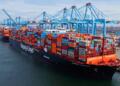
The restrictions implemented by the Panama Canal in recent weeks due to reduced water availability are beginning to impact shipping lines. Hapag-Lloyd warned that reduced daily transit capacity, draft limitations, and less available space are hindering service planning, increasing costs, and causing delays on various trade routes.
The German shipping company stated in a press release to its customers that the operating conditions of the interoceanic waterway currently pose a challenge to global maritime transport, after the Panama Canal Authority (ACP) intensified measures aimed at conserving fresh water and maintaining the safety of operations in the face of reduced water inflows and the effects associated with El Niño.
The situation has evolved rapidly. In addition to the draft modifications previously announced by the Panama Canal Authority (ACP), there has been a reduction in the number of available transit slots through the locks . Since September 3, the daily quotas in the Neopanamax locks have been adjusted to nine and those for Panamax to 25, while as of September 15, the latter will decrease to 23.
For Hapag-Lloyd, this reduced capacity is making it more difficult to secure transit slots , while draft restrictions limit the amount of cargo certain vessels can carry. Both factors are putting pressure on the planning of services that use Panama as a link between the Atlantic and Pacific Oceans.
The impact is also beginning to be reflected in costs. The shipping company identifies priority transit auctions, surcharges, and the need to consider alternative routes among the factors increasing the industry’s operating expenses. Hapag-Lloyd had previously announced a Panama Canal Surcharge of $130 per TEU (20-foot equivalent unit) for certain routes between the Far East and North America via Panama, applicable to departures beginning August 15.
Added to this are the bottlenecks that, according to the company, are causing significant delays on various trade routes. The limited availability of space also reduces shipping lines’ ability to quickly modify itineraries or redirect vessels, a crucial factor in networks where recovering lost days may require subsequent adjustments to port calls and rotations.
This situation marks a shift from the initial adjustments announced by the Panama Canal Authority (ACP) during the summer. At that time, the strategy focused primarily on gradually reducing the draft of Neopanamax vessels without altering the number of daily transits. However, lower-than-expected rainfall in the basin subsequently necessitated the implementation of capacity restrictions and changes to the berth allocation mechanisms.
The Panama Canal Authority also modified the draft restrictions schedule. The 48-foot (14.63-meter) limit, originally scheduled to take effect on August 26, was postponed to September 2, while the subsequent reduction to 47.5 feet (14.48 meters) , initially planned for September 3, was moved to October 1, based on changes in Gatun Lake levels and weather forecasts.
In parallel, the Canal has introduced temporary changes to its Reservation System to distribute available capacity among different segments of maritime transport. These modifications include a weekly allocation of 63 slots for Neopanamax vessels and a minimum allocation for container ships, LNG and LPG carriers, vehicle carriers, bulk carriers, and other segments.
For container ships , the Panama Canal Authority (ACP) has established at least five berths per reservation date, with allocation based on vessel capacity. This mechanism aims to utilize available capacity while simultaneously managing water consumption as the basin’s water deficit persists.
In response to this situation, Hapag-Lloyd is maintaining communication with the Panama Canal Authority (ACP) and its local partners to identify the best transit options, as well as implementing measures to restore schedules when disruptions occur. The company is also continuously analyzing potential alternative routes and adjustments to its network to reduce delays and maintain the flow of goods.
The shipping company has also indicated that it is looking to utilize available capacity in the older locks to move more vessels and reduce pressure on its services. Although circumnavigating South America is among the possible alternatives in the event of greater restrictions, the company has not yet resorted to that option.
The evolution of these measures thus places water once again as a variable directly linked to the Canal’s logistical reliability. What began with preventative adjustments to the draft has escalated to restrictions on the number of transits and modifications to the reservation system, while shipping lines are beginning to influence their cargo decisions, costs, schedules, and network configurations.
Comment and follow us on LinkedIn: @GrupoT21