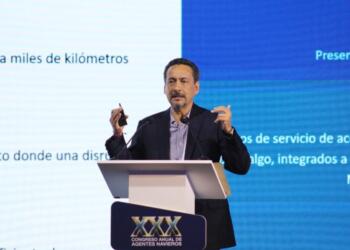
The second edition of ETYL Cali-Baja (Transportation and Logistics Meeting) will take place on May 14th. This region, comprised of San Diego and Imperial counties in the United States and Baja California in Mexico, has established itself as one of the most dynamic economic and logistics corridors in North America . Its location and industrial focus position it as a strategic area for cross-border trade and the ongoing reconfiguration of the region’s supply chains .
Data from the US Census Bureau indicates that in 2025, trade between the United States and Mexico reached a new milestone, with $872.834 billion in merchandise exchange , representing a 3.9% increase compared to 2024. Much of this trade was transported by land, across the border between California and Baja California.
In that context, the second edition of ETYL Cali-Baja 2026 , a forum organized by Grupo T21 , will bring together industry leaders and nearly 200 attendees at the Real Inn Hotel in Tijuana .
During the event, industry specialists will analyze the challenges and opportunities in the binational logistics context and its impact on supply chains, through four panels and a networking session to share success stories in transport, logistics and industry, with the aim of boosting competitiveness and innovation in the region.
The ETYL Cali-Baja 2026 program presents a robust and diverse agenda, with panels on current logistics, such as the one on Logistics Chains that are Redefining Cali-Baja , which will address the industries that are generating the real logistics demand: aerospace, electronics, medical devices and specialized manufacturing.
Factors such as specialized manufacturing in Mexico and research activities, as well as high-tech development and services in San Diego, have triggered a highly integrated binational ecosystem, according to the Binational Trade & Competitiveness Report 2025, prepared by the World Trade Center San Diego .
In the panel “Challenges and Opportunities of Maritime and Port Connectivity ,” specialists will discuss how the growth of maritime trade has enabled the development of new infrastructure and improved process efficiency. They will also talk about the modernization of the Port of Ensenada, Baja California, which in 2025 handled 427,499 TEUs (twenty-foot equivalent units), placing it fifth in the National Port System .
This port is relevant to binational trade, as a gateway to the industrial and production zones of the United States.

Key issues for improved cross-border logistics will be another panel at ETYL Cali-Baja 2026. It will address how the growth of bilateral trade has put pressure on border crossings, where peaks of more than 4,700 trucks are recorded in a single day between Tijuana and San Diego.
The infrastructure challenges at the Mexicali-Calexico crossing will also be discussed, as well as the progress being made in incorporating new infrastructure at Otay Mesa East .
According to the U.S. Bureau of Transportation Statistics (BTS) , the Otay-Tijuana border crossing is the second most important in trade with Mexico, which in 2025 totaled $59,978 million, with trucking being the main mode of exchange.
Machinery, parts and electrical equipment, together with vehicles, represent 40% of trade in this region.
According to studies by the San Diego Association of Governments (SANDAG) , it is projected that once fully completed, the aforementioned border crossing will reduce waiting times by up to 50% on average, which could generate a significant increase in the value of regional bilateral trade .
In the panel Customs, compliance and risks at increasingly demanding borders , specialists will discuss the new legal framework for foreign trade operations with new rules on security, documentation, inspection, traceability and risk management.
This issue takes on relevance within the framework of the new Customs Law, which came into force on January 1, 2026, among whose changes is the strengthening of the Electronic Customs System as the axis of all operations.
For more information about the ETYL Cali-Baja, you can visit https://baja.etylmx.com/ .
Given this scenario, Tijuana’s manufacturing industry seeks to strengthen the Cali-Baja area to attract and retain investment, especially for the advanced manufacturing industry.
In that sense, the United States and Mexico share this region, which has its own commercial dynamics and particular activity, so it is necessary to take care of it and continue to make it grow.
“It is a region that cannot be understood in any other way than through a joint dynamic. It is two countries in a single region,” highlighted Alonso Ibarra Arellano, president of the National Chamber of the Transformation Industry (Canacintra) Tijuana .
Comment and follow us on LinkedIn: @Humberto Cruz Moya / @GrupoT21