A giant doesn’t arrive suddenly. It announces itself loudly, yes, but it settles in quietly. And in the case of DP World , its arrival in Mexico isn’t a sudden incursion, but rather a presence that has been developing its capabilities, refining its offering, and now, explicitly stating its ambition, for at least two years: to deploy a logistical footprint that transcends the traditional discourse of freight forwarding .
The company’s formal launch in the country, held yesterday, revealed more than just a commercial expansion. It was, essentially, the unveiling of a model that seeks to reshape the way the supply chain is structured , at a time when the logistics market is experiencing structural tension: volatile rates, a concentration of power in shipping companies, and increasing pressure on intermediaries’ margins.
“We are a logistics integrator that can basically integrate all services within the supply chain,” summarized Francia Páramo, general manager of Freight Forwarding in Mexico, outlining the starting point of a company that seeks to differentiate itself not through rhetoric, but through the depth of its assets.
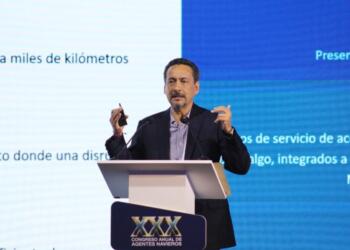
That is precisely the central theme running through DP World’s entire narrative. It doesn’t present itself as just another player in the saturated freight forwarder ecosystem , but rather as a structure that combines physical infrastructure with operational capabilities on a global scale. The figure is revealing: “10% of international freight moves through our terminals,” stated Carla Montenegro, Commercial Vice President for the Americas, when illustrating the reach of a network that spans more than 80 countries and 126,000 employees.
But the data alone doesn’t explain the bet. What the company is trying to capitalize on is a deeper transformation of the sector. “International transport has become a stock market ,” Montenegro warned, describing an environment where prices respond to geopolitical variables, disruptions, and cycles that no longer return to normal after the pandemic.
In this context, the asset-light model that has historically defined freight forwarding is beginning to show its limitations. “ Forwarders , those without assets , continue to shrink,” he noted, in a significant observation: the pure intermediation business is losing ground to structures that control infrastructure and can absorb or mitigate volatility.
This is where DP World is trying to position itself . Its central argument is that vertical integration—terminals, maritime services, land transport, warehousing, and contract logistics—can translate into operational control and, consequently, certainty for the customer. This is no small promise in a market where, as the players themselves acknowledge, logistics budgets can easily “boil over.”
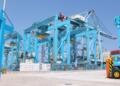
The scale of that infrastructure is part of the message. More than 79 port terminals , its own maritime operations on intra-regional routes, a dominant presence in Africa with 6,300 trucks, and logistical capabilities ranging from warehousing to specialized services for industries such as automotive and technology.

The example of the Jebel Ali port in Dubai serves as an operational metaphor for the model: a terminal that moves 20 million containers a year , surpassing complexes like Los Angeles-Long Beach, with highly automated operations. But beyond the data, what underlies it is a logic: control of critical nodes in the supply chain.
This logic also extends to the end customer. “We want to have a more strategic relationship with cargo owners,” Montenegro pointed out, implicitly acknowledging another market tension: the growing power of shipping companies , which “dictate prices and dictate the future of their products.”
The message is clear: DP World seeks to position itself as a counterweight in that equation, not through intermediation, but through infrastructure .
And in Aztec lands?
In Mexico, that ambition is beginning to take shape with a base that, although recent in its visibility, already has a certain degree of operational maturity. The company currently has five offices —Mexico City, Monterrey, Guadalajara, Querétaro, and soon Puebla—and five warehouses located in Monterrey, Juárez, San Luis Potosí, Querétaro, and Puebla.

“We offer the full range of services, from land freight, ocean freight and air freight, to contract logistics ,” explained Luis Segura, commercial director in Mexico, describing an offering that replicates, on a local scale, the global integration model .
However, beyond the existing infrastructure, the discourse points toward what’s to come. “We have big expansion plans in Mexico (…) we are going to be very strong, not only in logistics, but also in port operations ,” Montenegro stated, hinting that the country is not a tactical market, but a strategic one within their global network.
The stakes are high. In an environment where Mexico is gaining relevance as a logistics hub due to nearshoring , but at the same time faces structural bottlenecks —overburdened ports, stricter customs, and uneven land infrastructure —the promise of logistics integration faces a complex reality.
Therefore, more than the arrival of a new player, what is being tested is the viability of a model : whether vertical integration and asset control can effectively translate into efficiency and resilience in a market like Mexico’s.
DP World doesn’t just discover that market . It comes to compete for it. And it does so with a clear narrative: in an increasingly fragmented and volatile supply chain, whoever controls the infrastructure will also control the rules of the game.
Comment and follow us on LinkedIn: @Enrique Duarte Rionda / @GrupoT21