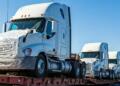
The saturation of the port of Manzanillo and the expansion work on the highway towards Colima are putting pressure on freight transport, generating congestion, longer travel times and additional costs for companies that depend on Mexico’s main commercial port, according to Yax Tzel Nolasco Gómez, president of the Manzanillo Freight Transporters Union (UTCM) .
According to UTCM , the combination of both factors has complicated the daily operations of carriers and is beginning to affect the entire logistics chain , from operators to importers and exporters.
“Today the port is experiencing considerable saturation, which has caused the collapse of each and every road leading to and from the port, as well as its entrance,” Nolasco noted.
He explained that congestion at the entrances forces cargo units to wait longer to enter or leave the port area, which increases operating costs and reduces the efficiency of freight transport.
Adding to this situation are the ongoing road widening works on the Manzanillo-Colima highway . According to Nolasco Gómez, one section has been under construction for over three and a half years without completion, while another recently began; however, both continue to cause problems due to a lack of signage, traffic coordination, and a more efficient response to congestion, particularly in the section known as La Salada .
The leader warned that these factors ultimately affect the country’s logistical competitiveness , as it is the port with the highest volume of containerized cargo in Mexico.
“We must not forget that, of every 10 containers that transit through the country, four enter through Manzanillo,” he stated, noting that any delay in this corridor affects the supply of goods for various productive sectors.
The disruptions to freight transport are occurring within a context of sustained growth in port activity. According to the National Port System Administration (Asipona) Manzanillo , between January and June of this year, the port handled 15.5 million tons of commercial cargo , a 4.9% increase compared to the same period in 2015. If total cargo is considered, including the movement of petroleum products, the volume reached 16.3 million tons , 5.5% more than last year.
This increase represents greater demand for the land infrastructure connecting the port to the rest of the country . During the same period, TEU (20-foot equivalent unit) traffic reached 2.07 million , 9.9% higher than in the same period of 2025, while vessel arrivals grew by 8.7% . These indicators imply a greater flow of goods and, consequently, increased traffic of freight trucks accessing the port area.
Regarding the surveillance of the corridor, he clarified that the problem is not the absence of the National Guard , but rather that the operational capacity is insufficient to handle the flow of vehicles that travel daily on the federal highway.
“Yes, there is a National Guard presence; the problem is that it’s not enough. We need more patrols and more support in terms of patrols,” he commented. He added that around eight thousand vehicles travel along this corridor daily , so he considered it necessary to strengthen the presence of authorities to respond more quickly to incidents and reduce disruptions to freight transport.
The need to strengthen coordination between authorities and stakeholders in the port community was also reflected in a document released by UTCM, in which the Manzanillo Customs Directorate proposes actions to address the congestion at the port’s entrances. According to information shared by the organization, these requested measures would involve the National Port System Administration (Asipona) Manzanillo , whose director general also chairs the Manzanillo Port Community (Copoma) .
According to UTCM, until the pending infrastructure is completed and measures are implemented to expedite access to the port, freight transport will continue to face delays that impact logistics competitiveness and Mexican foreign trade.
Comment and follow us on LinkedIn: @Karina Quintero / @GrupoT21