



Air cargo in Latin America maintains a positive trend during 2026, with a growth of 3.6% in the first half of 2026 (1H26), driven by the dynamism of exports and greater global demand for products from the region; however, it faces a challenge: insufficient airport capacity .
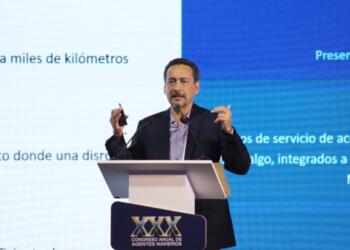
Peter Cerdá, executive director and CEO of the Latin American and Caribbean Air Transport Association (ALTA) , indicated that despite an environment marked by high fuel costs, the outlook for cargo remains favorable.
“The cargo is growing in a positive way, especially considering the high cost of fuel. Exports are increasing, and every day the products from this region are becoming more important and sought after worldwide,” he stated in an interview with T21.
However, he stated that future growth will depend largely on the ability of governments and airport administrators to accelerate infrastructure investments.
“We need to improve the infrastructure because demand requires it, so capacity will be important in that growth and we have to work with the government on a medium and long-term plan,” he said.
Cerdá warned that 54% of Latin American airports already have saturation problems , a situation that can limit both passenger transport and the movement of goods.
In the case of Mexico, he considered it essential to move forward with a long-term plan to strengthen airport capacity . While acknowledging that Mexico City International Airport (AICM) requires improvements to meet demand, he emphasized that the challenge is regional.
He specified that there are expansion and modernization needs at strategic airports such as El Dorado in Bogotá; Guarulhos in São Paulo; as well as in Lima, Peru, where work remains to be done, and Santiago, Chile. He also highlighted the investment announcements recently made in Argentina.
AIFA positions itself among the cargo ships
Regarding the possibility of cargo airlines returning to the Mexico City International Airport (AICM), Cerdá assured that most operators are happy at the Felipe Ángeles International Airport (AIFA) .
According to the executive, after a complex adaptation process following the transfer of cargo operations from AICM, companies have found favorable conditions at AIFA , particularly in terms of available infrastructure, operational capacity and absence of congestion.
“The cargo carriers are very happy at AIFA. I don’t think there will be many changes. There are a few specific companies that want to move, but most want to stay at AIFA; there’s good infrastructure and no problems with slots (takeoff and landing times),” he emphasized.
In that context, he argued that the positive aspect is that air cargo in Mexico continues to grow and that AIFA is playing an increasingly important role in logistics, unlike other airports in the region.
In the first half of 2026, AIFA handled 202,469.4 tons compared to 190,232.6 tons in the same period of 2025, which represented an increase of 6.4 percent.
Comment and follow us on LinkedIn: @Evangelina del Toro / @GrupoT21