



SAN PEDRO GARZA GARCÍA, NL – The modernization of Mexican customs stems from the authority’s own acknowledgment that its processes need improvement. Amidst the strengthening of its oversight powers, the National Customs Agency of Mexico (ANAM) is focusing on better data, new technological profiles within its ranks , and greater international information sharing. The remaining question is how these capabilities will translate into more agile and predictable procedures for foreign trade.
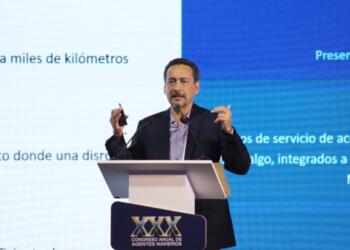
During the panel “Moving the world: logistics, infrastructure and resilient supply chains”, held within the framework of the 32nd Mexican Foreign Trade Congress , organized by the Mexican Business Council for Foreign Trade, Investment and Technology (Comce) , Estefanía Capdeville, general director of Customs Attention and International Affairs of ANAM, stated that digitization requires first reviewing the operation.
“Our processes are not working ,” he acknowledged, explaining the need to identify redundant activities and transform procedures before incorporating them into a system.
The accusation places direct responsibility on the institution. If the problem also lies in the design of the processes, demanding higher-quality information from users is insufficient : the authority must specify which procedures it will eliminate, how it will simplify validations, and what improvements will be obtained by those who properly certify their operations. The official’s statement did not detail time reduction targets or indicators to evaluate those results.
Capdeville explained that ANAM’s transformation includes incorporating specialists in digitization, systems, and data science. His own arrival, he recounted, was a response to this shift in profiles , following a career in international cooperation, telecommunications, and digital issues.
“I, Estefanía, am the consequence of the change we are experiencing,” she stated from the beginning of her speech.
The incorporation of technological capabilities can strengthen customs analysis, but it also demands knowledge of the processes it aims to transform. “I had never been inside a customs office before ,” Capdeville confessed.

The challenge is to integrate both experiences so that the design of customs systems responds to the conditions of dispatch and the diversity of foreign trade operations.
According to the official, one of the main obstacles is the quality of the information . Uploading an image or a scanned document to a platform, she explained, is not the same as providing data that the systems can use.
“This is a shared responsibility of both foreign trade users and foreign trade authorities,” he stated.
This shared responsibility requires verifiable conditions from both sides. Companies must provide consistent information; the authority must establish clear specifications , facilitate its transmission, and prevent the same data from being requested repeatedly without operational justification. Digitizing a redundant requirement retains its cost, even if the means of fulfilling it changes.
The discussion also showed that having more information does not automatically solve the problem of how to use it. Addressing ANAM’s priorities, Capdeville identified the declared value of goods and verification of their origin as central elements in combating practices that harm Mexican producers.
“ It’s not about raising revenue , it’s about protecting the national industry,” he argued.
The official linked this priority to the current customs reform and highlighted the interest in expanding information exchange with Asian countries, especially those in Southeast Asia. The goal is to understand the characteristics and history of the cargo before it is dispatched.
This approach can strengthen the early identification of risks. However, its effectiveness will depend on whether the information allows for better selection of operations requiring review and facilitates the verification of those that demonstrate compliance. Accumulating data without streamlining procedures can expand oversight capacity while simultaneously perpetuating administrative hurdles.
The proposal comes after Congress finalized the approval of changes to the Customs Law . The Senate endorsed the reform on October 13, and the decree was published in the Official Gazette of the Federation on October 23, with its entry into force scheduled for January 1, 2027.
The modifications strengthen the review of declared value and eliminate the 50% threshold that previously conditioned the grounds for precautionary seizure due to discrepancies in declared customs value between similar goods. The text incorporates provisions to differentiate the application of this ground through subsequent rules, which the authority must publish before the end of this year. Their implementation will be crucial in determining when a discrepancy warrants review and under what conditions the goods can be seized.
With greater powers comes increased importance for consistent criteria and timely mechanisms to resolve discrepancies. Combatting undervaluation requires evidence and analytical capacity; for operators, it also demands knowing how to substantiate their transactions and how to resolve disputes without unnecessarily prolonging uncertainty about the cargo.
Adriana Huerta, executive vice president of the Confederation of Customs Brokers Associations of the Mexican Republic (CAAAREM) , explained during the panel that the sector is working on the materiality of transactions, risk analysis, and the use of technological tools. Part of this effort involves guiding clients on what information they should share and how to back it up.

The task, however, extends beyond the file compiled by the customs agent. Silvia Armendáriz, manager of Livingston International , warned that the information can originate at another link in the chain : “Sometimes our data doesn’t even originate with us, but with our supplier.”

Therefore, he emphasized the need to connect systems to reduce manual data entry and errors . He also pointed out that having efficient platforms in different countries does not guarantee that they can communicate or transmit complete information.
The problem necessitates evaluating modernization as a coordination process. If suppliers, importers, customs brokers, and authorities cannot exchange data consistently, the additional requirements may translate into new data capture and reconciliation tasks.
ANAM acknowledged the need to transform its processes and is seeking tools for more precise oversight. The next step is to make this transformation verifiable . Data quality must translate into better-supported decisions, fewer redundant procedures, and greater certainty in dispatch. Otherwise, digitization risks becoming yet another layer of requirements on top of an operation whose shortcomings the authority itself already recognizes.
Comment and follow us on LinkedIn: @Enrique Duarte Rionda / @GrupoT21