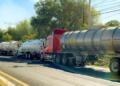


Installing a diesel tank within their own infrastructure, receiving fuel directly from a supplier, and supplying their fleet without depending on a service station was the way various trucking companies operated; however, the lack of clarity in the new regulatory framework for self-consumption of fuels has discouraged some companies from registering .
These self-consumption yards, also known as self-consumption yards, which emerged as an alternative to reduce fuel costs and have greater logistical control, face the challenge of proving their technical conditions, demonstrating the legal origin of the product, and complying with applicable regulations.
For the trucking industry, where diesel is one of the critical inputs to continue its operation, regulation may require a review of both infrastructure and supply contracts.
Enrique Loyo, CEO of UV Consulting Group , indicated that the opportunity to purchase fuel at a lower price prompted some carriers to install tanks and dispensers within their yards . In some cases, suppliers offered to install the infrastructure as part of the commercial agreement, which facilitated the investment decision.
The problem is that some facilities were built with used tanks, single-walled tanks, or tanks without the necessary technical elements, in addition to the lack of volumetric control systems to record how much fuel entered, how much was stored, and how much was dispensed to each unit, he pointed out.
The Official Mexican Standard NOM-005-ASEA-2016 establishes specifications for the design, construction, operation, and maintenance of service stations for the storage and sale of diesel and gasoline. Its application must be reviewed according to the characteristics of each facility and the corresponding regulations, in accordance with the Official Gazette of the Federation (DOF) .
A large-capacity tank can cost around one million pesos, and when incorporating dispensers, volumetric controls, and other components, the total investment can range between three and five million pesos, depending on the size and characteristics of the installation, Loyo estimated.
The savings that justified installing the module must be compared with the cost of adapting it to the regulations, in addition to the expenses of inspection, maintenance and operation .
Therefore, the specialist considered that some carriers are becoming discouraged from participating in the registration program; not necessarily because they do not want to regularize their operations, but because the infrastructure offered to them does not meet the requirements.

As of October 21, 2026, 1,596 registrations had been recorded with the National Energy Commission (CNE) , and time is running out, since companies that manage self-consumption have just over two months to register.
The CNA program, published in the Official Gazette of the Federation (DOF), established a registration period that ends on December 31, 2026. The objective is to identify facilities that dispatch electricity for self-consumption and facilitate their transition to the corresponding permitting regime.
It should be clarified that the registration certificate is not equivalent to a permanent permit. It is a temporary mechanism that allows the activity to continue under the conditions stipulated in the program, while the applicable regulations are being issued and the permit is being processed.
Registering does not automatically guarantee compliance for any facility . Those interested must provide information on facilities, tanks, dispensing systems, supplied vehicles, consumption volumes, and suppliers, as well as proof of the hydrocarbon’s origin.
Loyo pointed out that companies should check who they buy fuel from. Receiving an invoice does not guarantee that the supplier has the necessary authorization to carry out the activity.
“So, who am I buying from? Am I complying or not?” the executive summarized, describing the questions that carriers are asking themselves in the face of the regularization process.
The Hydrocarbons Sector Law , published on March 18, 2025, includes permits for various activities within the petroleum supply chain, among them fuel dispensing for self-consumption. Its regulations stipulate that this modality consists of receiving, storing, and supplying fuel exclusively to vehicles owned or possessed by the permit holder, related to their economic activity, without selling it to third parties.
Therefore, companies must review both the status of their own facilities and that of the supplier or distributor that provides them. Documentary traceability of fuel becomes part of fleet management, along with inventory control and purchasing planning.
According to Loyo, the risk is that companies may have made decisions based on commercial offers that did not clearly explain their regulatory obligations. He believes that the carrier should not be held generally responsible, but stressed the need to verify the legality of the supplier and the conditions of the facility.
What happens if the module is not regularized?
Uncertainty about what will happen after December 31 also weighs on companies’ decisions, as it is impossible to anticipate whether the authority will establish an extension, issue additional provisions , or define a procedure for facilities that fail to register.
Loyo suggested that some companies might suspend the use of their kiosks while they learn what measures they will need to take. An alternative to avoid halting operations would be to return to service stations , provided that supply, location, and operational conditions allow it.
The challenge for transport companies will be to prevent regulatory compliance from resulting in unexpected disruptions.
From Loyo’s perspective, the solution lies in having clear rules and a roadmap that allows companies to identify what they need to correct to operate within the regulations . He also considered it advisable for the authorities to specify what will happen to facilities that fail to register within the established timeframe.
His message to the sector is not to rule out self-consumption as a tool for managing fuel, but to review the necessary conditions to keep it within the legal framework.
“What I truly hope is that the transport and logistics sector will realize that good things are coming, and that if they comply with the regulations, they can have their self-consumption modules operating under the protection of the law,” he concluded.
The Midstream Forum Mexico 2026 will take place on November 3rd at the Marquis Reforma Hotel in Mexico City, where energy sector specialists will discuss the distribution, handling, transportation, and marketing of hydrocarbons in the country.
Comment and follow us on LinkedIn: @Humberto Cruz Moya / @GrupoT21