


Mexico seeks to increase the participation of national companies and suppliers in energy projects through new methodologies to measure, verify and certify national content in the hydrocarbon, electricity and biofuels industries and to increase this requirement from 35% to 40%.
The goal is to strengthen local production chains, reduce dependence on imported inputs, and offer greater certainty about the origin of the goods and services incorporated into these activities.
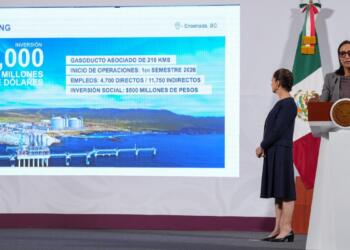
At a press conference, Marcelo Ebrard, head of the Ministry of Economy (SE) , presented the methodologies as a mechanism to unify criteria that until now were scattered across different regulations. The ministry seeks, in addition to complying with legal obligations, to identify what portion of energy purchases, contracts, and investments actually remains in the country.
“The goal is to measure the national content in one of the most important sectors of the Mexican economy. We want to be able to monitor it and, at the same time, promote an increase in national content,” the federal official stated.
According to Ebrard, the change also has an operational implication: the deadline for certifying national content will be reduced from 18 months to 90 calendar days . The intention is to streamline procedures for companies and have verifiable information that allows for evaluating compliance with the percentages established in the regulations, in accordance with Article 74 of the corresponding energy laws, enacted on March 18, 2025.
The measure is closely linked to the “Made in Mexico” strategy . “Certifying that it was indeed carried out in our country, manufactured in our country, or designed in our country, or produced in our country,” he stated.
Alberto Uribe Camacho, Director General of National Content and Promotion in the Energy Sector, reported that, between October 2024 and October 2026, the SE issued 320 technical opinions related to national content compliance programs for the exploration, evaluation and development stages.
These programs are associated with planned investments of $152.024 billion over the next 30 years . Of that amount, $60.811 billion would correspond to national content, equivalent to 40% of the investment considered, above the 35% threshold established in the regulations.
He added that, during the same period, 31 verification procedures for national content expenditure were carried out, through which an amount exceeding 223 million dollars was verified.
National content is not limited to assembling equipment in Mexico or hiring local labor. According to Uribe, the methodologies consider goods and services of national origin, Mexican workers, specialized training, investment in local and regional infrastructure, as well as technology transfer and innovation.
This final dimension aims to ensure that projects not only generate domestic purchases but also contribute to the development of technical capabilities. To advance this objective, the Ministry of Economy is working with institutions such as the National Autonomous University of Mexico (UNAM) , the Mexican Petroleum Institute (IMP) , and the National Polytechnic Institute (IPN) to connect research projects and laboratories with the needs of energy companies, including Petróleos Mexicanos (Pemex) .
Another step announced this Monday, October 19, was to strengthen the catalog of goods and services and the registry of national suppliers for the three industries . The agency plans to work with Pemex, companies based in Mexico, and state economic development secretariats to identify suppliers operating in different regions and detect opportunities for small and medium-sized enterprises (SMEs) to join the supply chains .
This point is relevant for logistics and transportation, since energy projects require a supply network that includes equipment, materials, technical services, infrastructure, and the movement of goods.
Traceability of origin will be another important component. Ebrard emphasized that international trade will increasingly prioritize rules of origin, which determine where a product is manufactured and what inputs it incorporates. In this context, documenting the origin of goods and services can help companies demonstrate compliance with the applicable regulations for their business operations.
In this regard, the Ministry of Economy has explained that its National Content and Energy Sector Development division is responsible for measuring national content and promoting local production chains. Electricity sector legislation also includes a methodology for measuring and verifying this participation, while the Hydrocarbons Law establishes a minimum average of 35% for exploration and extraction activities.
The methodologies presented are part of a broader strategy to develop Mexican suppliers and monitor compliance with sector obligations. The outcome will be measured not only by the speed of the procedures, but also by the ability to translate the regulations into more contracts for Mexican companies, greater technological development, and broader productive participation in energy investments.
Comment and follow us on LinkedIn: @GrupoT21