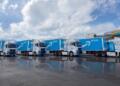
The tractor-trailers waiting to enter the port of Manzanillo occupy space on roads that must also handle city traffic. To reduce this pressure, the Manzanillo National Port System Administration (Asipona) and trucking organizations prepared a pilot program that would concentrate trucks at the Land Regulation Center (CRT) and regulate their departure toward Contecon Manzanillo , the operator of the Specialized Container Terminal (TEC) II. The project had been in development for weeks, but its public announcement sparked a disagreement over who should communicate the change and when it would take effect.
The immediate consequence fell on the truckers. On September 23, the Manzanillo Port Community (Copoma) instructed them that the following day they had to go to the CRT (Regional Transportation Center) before attending certain appointments at Contecon. Hours later, the terminal asked them to maintain their usual entry procedure . For a trucking company, deciding which instruction to follow meant risking their truck’s schedule and, consequently, the cargo’s scheduling and delivery.
The evidence originates from minutes of the September 3rd Copoma-Asipona-transporters meeting, obtained by T21. Isaí Martínez, representative of Asipona Manzanillo, stated during the meeting that the strategy had been in preparation for over a month and that the transportation associations had proposed starting with Contecon . Representatives from the City Council, Copoma, Conatram , UTCM, UETLM, and the National Chamber of Freight Transportation (Canacar) also participated . Contecon is not listed among the registered attendees, so the minutes do not prove that the terminal approved the plan at that meeting.
Martínez explained that the new CRT project (located at kilometer 3.5 of the Manzanillo-Minatitlán highway) would also utilize an adjacent space formerly occupied by TIMSA —which also operates a multi-purpose terminal at the port—to concentrate trucks and regulate their flow toward the port area. He also indicated that additional areas could be freed up starting in December and that, if the pilot program proved successful, its application would be evaluated at other terminals. Héctor Venancio, general director of Copoma, linked the proposal to the need to reduce the number of vehicles on municipal roads and increase their turnover.
Choosing Contecon as the starting point also places the test at one of the port’s highest-volume operations. According to official figures compiled by terminal from January to August 2026, Manzanillo handled 2,824,836 twenty-foot equivalent units (TEUs), compared to 2,544,369 in the same period of 2025, an 11 percent increase. Contecon handled 1,186,477 TEUs, 20.2% more than the 987,017 of the previous year . Its operation represented 42% of the port’s total container volume during those eight months. This share allows us to gauge the potential scope of a test focused on its access points, although the TEUs handled do not equate to the number of tractor-trailers that would use the CRT (Container Receiving Terminal).
The meeting also defined how the first phase would operate. It was proposed that Contecon import appointments would be scheduled starting at 4:00 PM, primarily on Wednesdays, Thursdays, and Fridays. Trucks would arrive at the CRT approximately two hours before their appointment and depart about an hour earlier in a convoy toward the terminal’s second access point, traffic conditions permitting. Participants also discussed how to identify these trucks, either through appointment scheduling or electronic documentation.
The trial was implemented alongside another extension of operating hours aimed at facilitating the clearance of goods. According to the same minutes, the Manzanillo Customs Office began processing imports 24 hours a day on Thursdays and Fridays . Martínez noted that this schedule could benefit the CRT’s operations: it would allow for the distribution of operations over more hours, provided that the flow of trucks to the terminal and access points could also be coordinated.
The minutes state that attendees unanimously agreed to proceed with the use of the CRT (Centralized Traffic Response Center) for these operations. Among the agreements reached were the concentration and allocation of traffic units, adjustments to the Tapeixtles-bypass interchange, and an evaluation of the trial run before its expansion . It was also noted that the availability of traffic management personnel would be limited during the construction in Manzanillo.
This specific plan relies on an existing facility with general rules. The Rules for Use of the Land Traffic Regulation Center at the Regulating Yard , issued weeks ago by Asipona Manzanillo and reviewed by T21, stipulate that the port authority, through its Land Traffic Control Center (CCTT) , authorizes the use of spaces according to vehicle flow and operational needs. They allow for trucks to be routed to the CRT when a terminal experiences delays, access points become congested, or units arrive with appointments for later times. They also indicate that the commencement of space use must be announced through authorized official channels.
The rules, therefore, describe what the CRT can be used for and who manages its operation. They do not, in themselves, stipulate that Contecon appointments from 4:00 PM onwards must pass through the yard on Wednesdays, Thursdays, and Fridays, nor do they establish the convoy departure time scheduled in the minutes. Implementing this trial required clearly communicating to the carriers when it would begin and what the recognized procedure would be for accessing the terminal.
The time and costs associated with the port cycle explain the importance of avoiding further delays. According to the Average Trucking Time Indicator (ITPAP) for August , compiled by T21 Business Intelligence, the average time observed for import container operations in Manzanillo decreased from 12 hours, 50 minutes, and 27 seconds in July to 9 hours, 34 minutes, and 30 seconds in August. The same study estimated 414.9 million pesos per month in resources associated with trucking downtime in Manzanillo , considering diesel, drivers, and tractor-trailers. This figure does not represent verified accounting losses, nor does it measure the potential impact of the CRT test. The ITPAP is based on data shared by GPS and trucking companies, not on all trips through the port.
The CRT scheme had already been publicly mentioned before September 23. Four days earlier, Yax Tzel Nolasco Gómez, delegate of the National Confederation of Mexican Carriers (Conatram) in Colima and president of the Manzanillo Freight Carriers Union (UTCM), told the newspaper Hechos that tests were being prepared primarily for units destined for Contecon . He indicated that the yard would be used when saturation made it necessary to regulate entry and that its initial operation would allow for adjustments to be identified.
Copoma took the next step on September 23. In a statement, it announced that starting Thursday, September 24, trucks with appointments from 4:00 PM onward to Contecon would first need to enter the CRT (Regional Transportation Center), arrive two hours early, complete a PIS Check (Pilot Inspection System), and depart in convoy one hour before their appointment. The notice added that trucks that did not follow this procedure “will not be allowed to enter the facility .” Although the schedule and route largely correspond to what was discussed on September 3, neither the minutes nor the CRT’s general rules explicitly state this consequence for this test.
Contecon responded that same day. In its “Important Notice Regarding Use of the Regulating Yard,” it stated that the scheme disseminated by Copoma “was neither coordinated nor agreed upon with our Terminal” and that the association’s statement did not constitute a valid operational instruction for changing its users’ access. It requested that the current procedure be maintained until any modification was communicated through the appropriate official channels and, where applicable, had the support and authorizations of Asipona or the competent authority. The notice appears in the terminal’s communications section for transport companies.
A T21 source with knowledge of the discussions at the port indicates that Contecon personnel participated in other meetings and that their objection related to the way in which Copoma, whose president is the general manager of Asipona Manzanillo, communicated the measure. This explanation remains attributed to the source; it does not alter the fact that Contecon publicly disavowed the notice, nor does it allow us to conclude that it passed the test recorded in the minutes of September 3.
According to a second source close to the Contecon operation, the procedure announced by Copoma was not applied on Thursday the 24th .
Furthermore, it is known that a new meeting with all those involved will be held next Monday, September 28, to resolve this situation; however, the CRT issue is ongoing.
Concentrating trucks outside the terminal could alleviate traffic congestion in Manzanillo if their departure is coordinated with the actual capacity of the access roads and the terminal itself. The effect of the trial cannot yet be determined. Before measuring it, Asipona and the stakeholders involved will have to specify when the procedure will begin, which units it will apply to, and how a single instruction will be communicated. As long as the uncertainty persists, it is the carriers and the cargo that bear the immediate consequences: committed equipment time, trips that must be rescheduled, and deliveries whose timing becomes unpredictable.
Comment and follow us on LinkedIn: @Enrique Duarte Rionda / @GrupoT21