In Mexico, the hours a tractor-trailer spends tied up during port operations have consequences that extend beyond productivity. While the unit is not completing its cycle, the transport company maintains resources allocated to fuel, the driver, and the equipment itself , while simultaneously reducing its availability to perform new services and generate revenue.
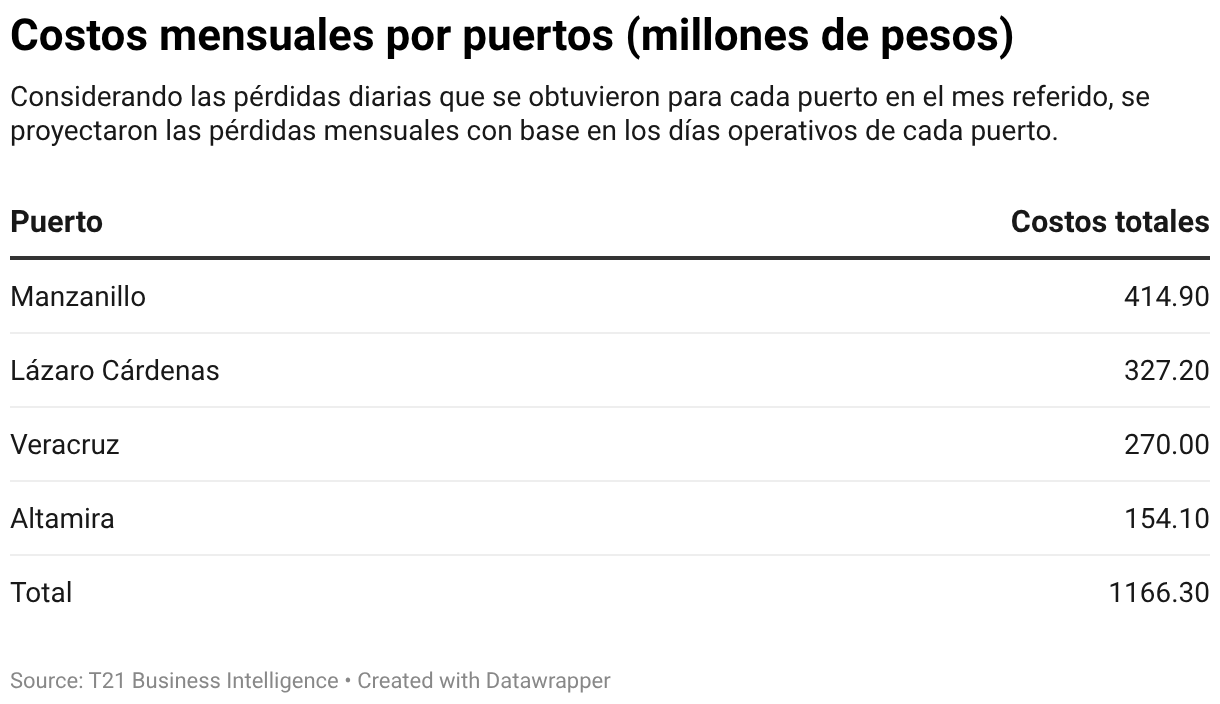
An analysis by T21 Business Intelligence , based on times recorded by the Average Time Indicator for Road Transport in Ports (ITPAP) , estimates that delays in Manzanillo, Lázaro Cárdenas, Veracruz and Altamira, the country’s main ports for handling containerized cargo, represent a combined associated cost of 1,166.3 million pesos (mdp) per month for road transport, considering the operating days of each facility.
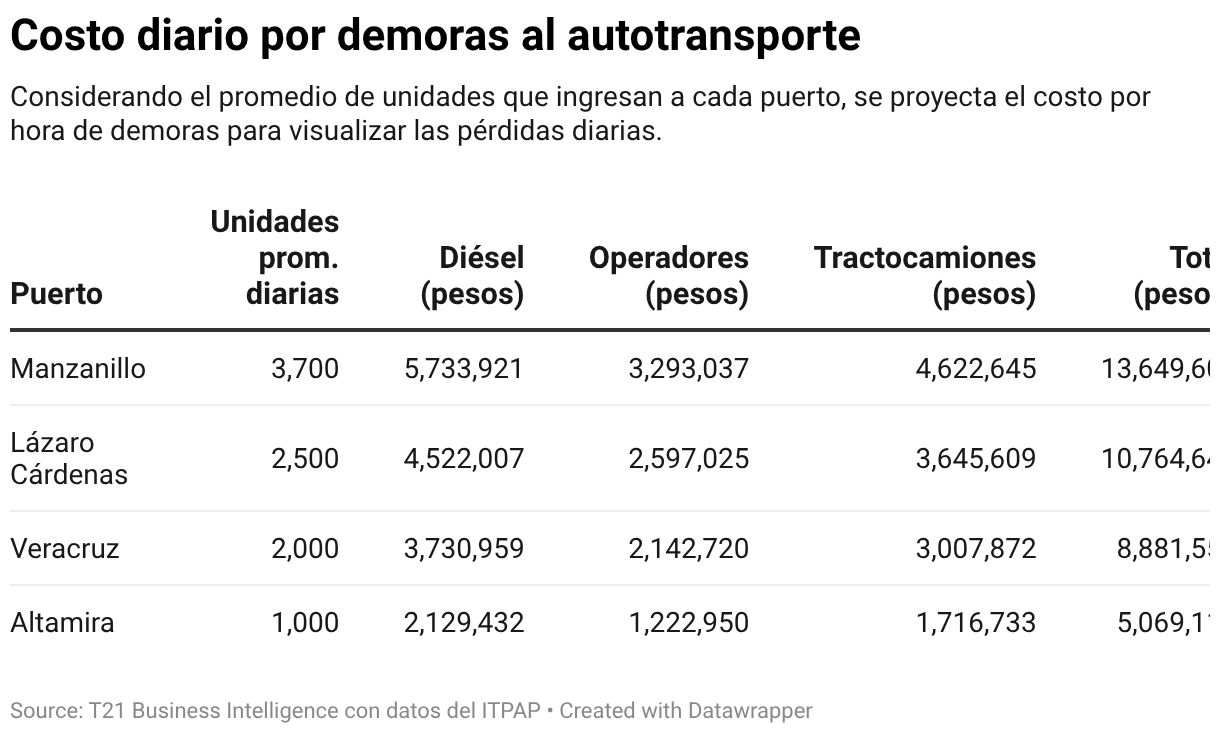
The exercise considers three components directly linked to the immobilization of equipment: diesel, operators, and tractor-trailer trucks . Relating these to the average daily flow of vehicles entering each port, the potential impact reaches approximately 38.4 million pesos daily across the four facilities.
Manzanillo accounts for the largest share , with an estimated 13.6 million pesos daily, based on an average flow of 3,700 vehicles. It is followed by Lázaro Cárdenas, with 10.8 million pesos and 2,500 vehicles; Veracruz, with 8.9 million pesos and 2,000 vehicles; and Altamira, with 5.1 million pesos daily and around 1,000 vehicles.
When projecting these impacts based on the operating days considered during August, the associated cost amounts to 414.9 million pesos per month in Manzanillo, 327.2 million pesos in Lázaro Cárdenas, 270 million pesos in Veracruz and 154.1 million pesos in Altamira.
More than just an accounting loss actually recorded by companies, this exercise allows us to quantify the resources committed due to delays . An additional hour not only prolongs a unit’s stay: it keeps capital, operators, and operational resources tied up, while reducing the tractor-trailer’s capacity to complete other transport cycles.
ITPAP shows improvement in August
From this perspective, the ITPAP’s performance during August takes on a new dimension. The average time decreased from 11 hours, 50 minutes, and 23 seconds in July to 10 hours, 40 minutes, and 39 seconds in August , an improvement of one hour, nine minutes, and 44 seconds.

By August, the ITPAP—generated from information shared by GPS and trucking companies with T21—considered 2,273 trucking movements of imported container cargo at the four ports analyzed. The reduction in the overall average, however, did not translate into a general improvement: Manzanillo and Lázaro Cárdenas saw decreases in their transit times , while Veracruz and Altamira registered considerable increases.

All three components of the ITPAP showed a reduction compared to the previous month. Customs processing time decreased from 5:44:56 to 5:14:26 hours , an improvement of 30 minutes and 30 seconds; maneuvering time decreased from 2:34:14 to 2:17:09, a reduction of 17 minutes and five seconds; while waiting time fell from 3:31:13 to 3:09:04, a reduction of 22 minutes and nine seconds.
The distribution, however, maintains a pattern that has been repeated throughout the year. In August, customs accounted for 49.1% of the overall average time, while waiting represented 29.5% and handling 21.4%. In other words, practically one out of every two minutes spent was associated with the customs component.
Manzanillo moves from last to first place
The most significant change occurred in Manzanillo. After registering the longest time among the four venues in July, with 12:50:27, in August it reduced its average to 9:34:30, an improvement of 3:15:57 hours.
The adjustment occurred in all three components. Customs decreased from 6:11:30 to 4:40:22; maneuvering, from 2:45:48 to 2:03:35; and waiting, from 3:53:08 to 2:50:32.
With this, Manzanillo caused a major shift in the ITPAP ranking: it went from having the longest wait time in July to registering the shortest among the four ports during August.
Lázaro Cárdenas maintains its downward trajectory
Lázaro Cárdenas also managed to reduce his times, although more moderately. His average went from 11:58:58 in July to 11:17:45 in August, an improvement of 41 minutes and 13 seconds.
Customs went down from 5:52:52 to 5:32:16; maneuvers, from 2:36:49 to 2:24:08; and waiting, from 3:29:17 to 3:21:21.
This trend continues the recovery that began after April, when Lázaro Cárdenas reached 16:53:10, its longest time in the first eight months of the year. Although July briefly interrupted this trend, August brought the indicator back down.
Veracruz reverses the improvement
The situation was different in Veracruz. After topping the July ranking with 7:13:01, the average time increased to 11:31:59 in August, a difference of 4:18:58, the largest negative variation among the four ports.
The deterioration also affected all three components: customs went from 3:32:16 to 5:39:08; maneuvers, from 1:37:58 to 2:33:08; and waiting, from 2:02:47 to 3:19:43.
With this result, Veracruz went from first to third place in just one month , again demonstrating the volatility that service times for road transport can present between consecutive periods.
Altamira records the longest August weather
In Altamira, the average increased from 9:36:28 in July to 13:09:39 in August, an increase of 3:33:11 that placed it as the port with the longest time of the month.
Customs advanced from 4:36:02 to 6:38:48 ; maneuvers, from 2:06:48 to 2:46:23; and waiting, from 2:53:38 to 3:44:27.
The result also represents the second longest time recorded by Altamira during the first eight months of 2026, just below the 13:35:29 observed in March.
Thus, August once again showed that the average only tells part of the story. While the overall ITPAP improved by just over an hour, Manzanillo and Lázaro Cárdenas reduced their times , but Veracruz and Altamira moved in the opposite direction, again causing significant changes in the relative performance of the venues.
The analysis becomes even more relevant when hours are translated into economic resources. For trucking, port productivity doesn’t end with an improvement or decline in an indicator: every minute a unit is idle affects asset utilization, the operator’s available time, and the possibility of completing future trips. This relationship between time and cost is what allows us to understand why efficiency within ports extends beyond their facilities and ultimately impacts the rest of the logistics chain.
Comment and follow us on LinkedIn: @GrupoT21