The recovery in truck turnaround times at Mexico’s main ports during May and June hit a turning point in July of this year. The Average Truck Turnaround Time Indicator at Ports (ITPAP) registered an average of 11 hours, 50 minutes, and 23 seconds , compared to 6 hours, 33 minutes, and 43 seconds a month earlier.
The difference represents an increase of 5 hours, 16 minutes and 40 seconds , equivalent to 80.4%, and places the indicator back close to the levels recorded during the months of greatest operational pressure so far in 2026.
In July, ITPAP analyzed 2,327 truck movements at the ports of Manzanillo, Lázaro Cárdenas, Veracruz, and Altamira, with support from GPS operators and trucking companies. The trend was widespread: all four ports registered longer service times compared to June, although with significant differences in the extent of the decline.
The trend was also reflected in each of the processes that make up the index. The average time for customs procedures increased from 3:13:12 in June to 5:44:56 in July, an increase of 2:31:44. Maneuvering time increased from 1:25:53 to 2:34:14, while waiting time rose from 1:54:38 to 3:31:13.
Thus, practically half of the total time was again concentrated on customs processes , with a 48.6% share; waiting accounted for 29.7% and maneuvering, 21.7%. The distribution maintains a pattern that ITPAP has identified in previous months: regardless of the differences between ports, customs processing continues to be the component that absorbs the most time within the operational cycle.
Manzanillo registers the greatest deterioration
The most pronounced change during July occurred in Manzanillo . The port had closed June with an average of 5:34:16, but a month later the indicator climbed to 12:50:27, a difference of 7:16:11.
The deterioration was distributed among the three components. Customs increased from 2:43:36 to 6:11:30; maneuvering went from 1:12:56 to 2:45:48; and waiting advanced from 1:37:43 to 3:53:08.
With this result, Manzanillo not only went from second to fourth place among the ports analyzed, but also recorded its highest average time in the first seven months of 2026, even surpassing the levels observed between February and April.
This behavior contrasts sharply with May and June, when the venue had managed to stay slightly above five hours. Thus, July abruptly halted the improvement shown during the previous two months.
Lázaro Cárdenas is once again approaching 12 hours
In Lázaro Cárdenas, the average time went from 8:28:25 in June to 11:58:58 in July , an increase of 3:30:33.
Customs advanced from 4:09:42 to 5:52:52; maneuvers from 1:51:02 to 2:36:49; and waiting from 2:27:40 to 3:29:17.
The result also marked a change from the downward trend the port had experienced after April, when it reached 16:53:10, its highest time of the year. May had reduced the indicator to 9:31:19 and June to 8:28:25, but July brought it back practically to the 12-hour mark .
Altamira relinquishes first place
Altamira, which in June had the shortest time among the four venues analyzed, did not escape the general deterioration either.
His average increased from 5:19:46 to 9:36:28 , a difference of 4:16:42.
The customs component went from 2:38:23 to 4:36:02; maneuvers increased from 1:05:17 to 2:06:48; and waiting advanced from 1:36:06 to 2:53:38.
The change moved Altamira from first to second place in the monthly ranking . Even so, its result remained below the 13:35:29 recorded in March, the longest episode for this port during 2016.
Veracruz is containing the increase better.
In a July marked by longer times, Veracruz showed the least variation among the four ports and ended up leading the ITPAP ranking.
The average went from 6:15:26 in June to 7:13:01 in July , just 57 minutes and 35 seconds more, compared to increases of more than three, four and seven hours in the other venues.
Customs increased from 3:04:10 to 3:32:16; maneuvers went from 1:26:50 to 1:37:58; and waiting advanced from 1:44:25 to 2:02:47.
With this, Veracruz went from third place in June to first in July , followed by Altamira, Lázaro Cárdenas and Manzanillo.
Port |
June |
July |
Variation |
Veracruz |
6:15:26 |
7:13:01 |
+0:57:35 |
Altamira |
5:19:46 |
9:36:28 |
+4:16:42 |
Lázaro Cárdenas |
8:28:25 |
11:58:58 |
+3:30:33 |
Manzanillo |
5:34:16 |
12:50:27 |
+7:16:11 |
An indicator that returns to double-digit territory
Looking at the first seven months allows us to better understand the change in July. The ITPAP started January with 8:47:33, increased to 11:09:20 in February and 12:56:32 in March, reaching 13:05:46 in April, the highest national average for the period.
Then came a considerable correction . May reduced the indicator to 7:01:07 and June deepened the improvement to 6:33:43, the best result recorded in 2016.
July reversed a significant part of that progress, settling at 11:50:23. This made it the third longest average time of the year , only behind March and April, and returned the indicator to a double-digit level.
Beyond the monthly fluctuations, the results again demonstrate the sensitivity of port operations to the various stages that trucking must complete within the port facilities. In July, the decline was not caused by a single factor: customs, handling, and waiting times increased simultaneously, although with varying degrees of intensity from one port to another.
And those hours have consequences that extend beyond the terminal doors. For transport companies, a vehicle stopped for longer periods reduces its capacity to complete trips , limits the productive kilometers it can travel, and forces them to allocate more resources to meet the same demand.
It is precisely this dimension that ITPAP will begin to incorporate into its analysis: not only how long road transport remains in ports, but what the cost is to companies and the logistics chain of losing productivity during those hours.
Even the time lost has a cost
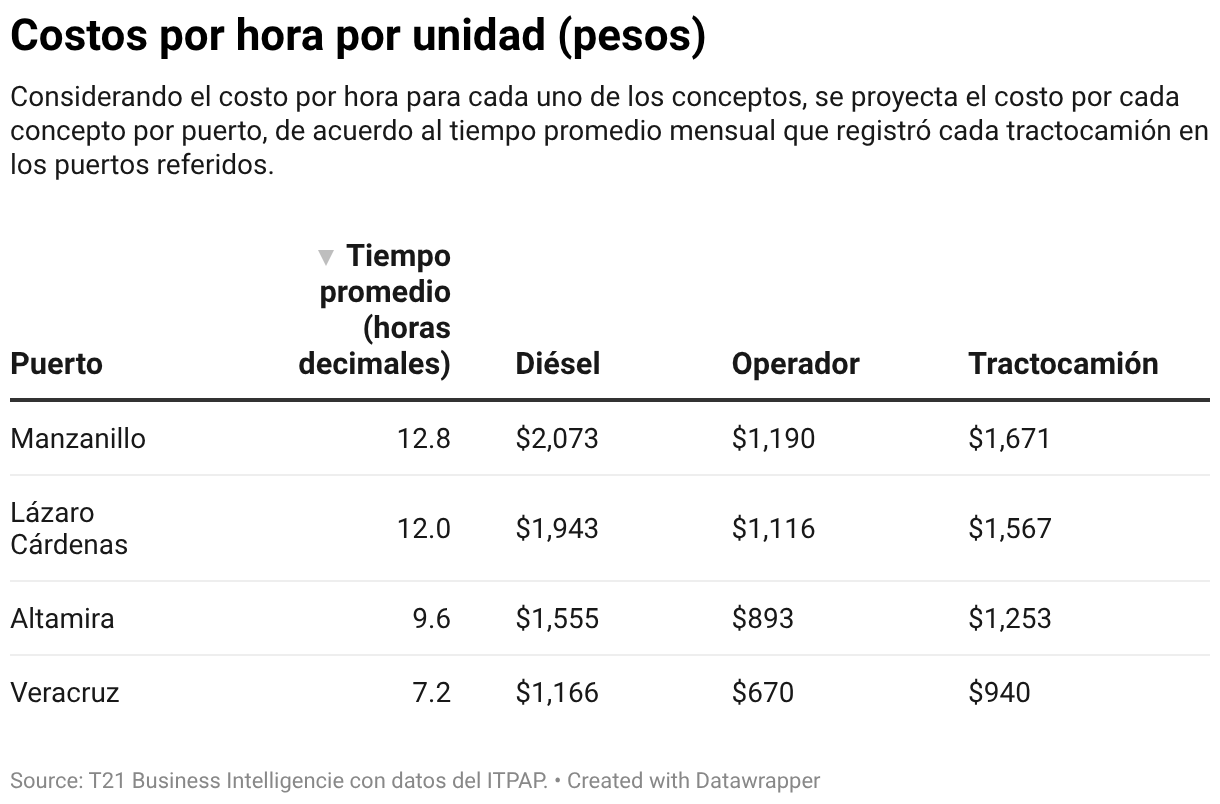
The impact of port delays doesn’t end with operations. A T21 Business Intelligence study quantifies the cost to transport companies of keeping their equipment idle during the hours required to service each port, considering three main components: fuel (diesel), operator, and tractor-trailer .
With the average times considered in the exercise, Manzanillo presents the highest cost per unit, with around four thousand 934 pesos for each cycle affected by delays; followed by Lázaro Cárdenas, with four thousand 626 pesos; Altamira, with three thousand 701 pesos; and Veracruz, with two thousand 776 pesos.
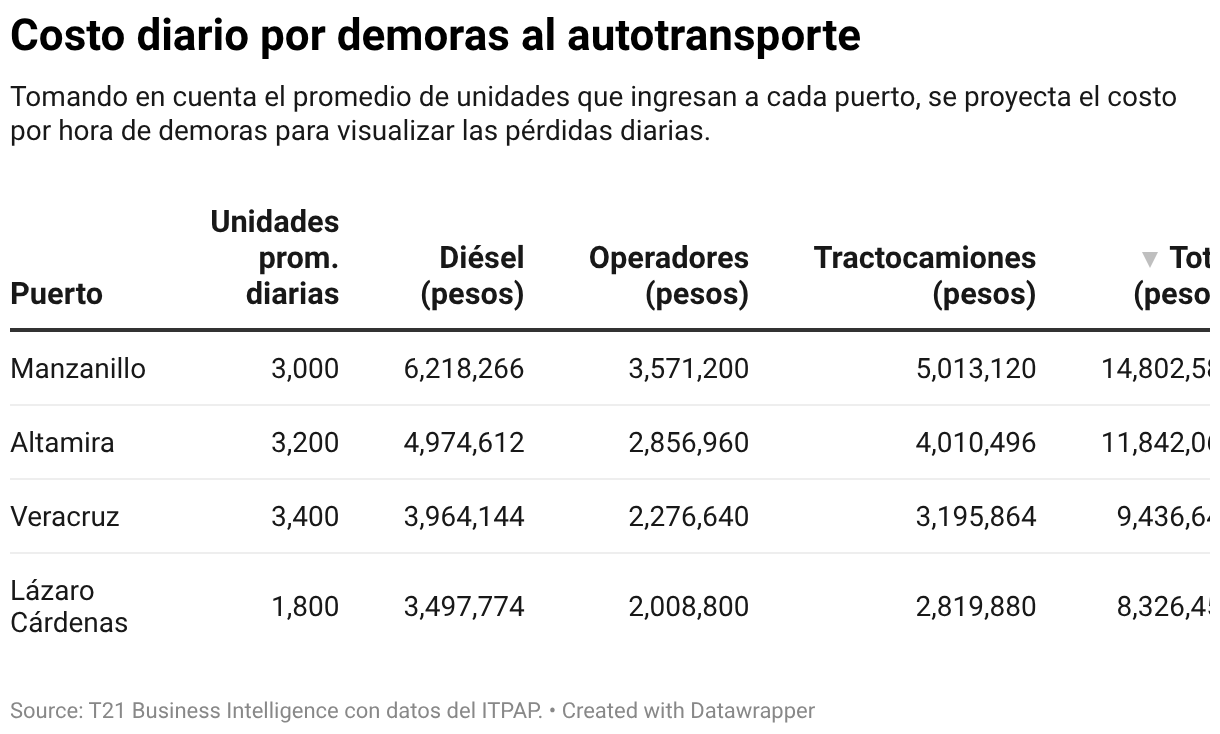
The scale changes when these costs are applied to the average daily flow of trucking. Considering approximately 3,000 trucks in Manzanillo, 1,800 in Lázaro Cárdenas, 3,200 in Altamira, and 3,400 in Veracruz, the estimated combined impact reaches approximately 44.4 million pesos per day across the four ports.
Manzanillo would be most affected, with daily losses of 14.8 million pesos, followed by Altamira with 11.8 million, Veracruz with 9.4 million, and Lázaro Cárdenas with 8.3 million. More than just a problem of waiting time, these figures illustrate how port inefficiencies can directly impact the cost structure of trucking and, eventually, the rest of the logistics chain.
Comment and follow us on LinkedIn: @GrupoT21