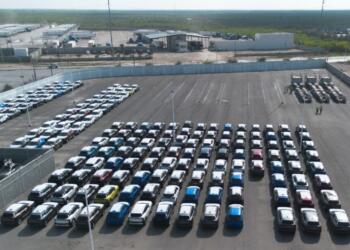
The industrial corridors in Mexico of Zumpango-AIFA, Torreón, Salinas Victoria and the southeast region have consolidated themselves as some of the fastest growing markets in recent years, excluding the Development Poles for Well-being (Podebis), promoted by the federal government.
Samuel Campos, executive Managing Director at Newmark Mexico, said in his participation in the Industrial & Logistics Summit, organized by Inmobiliare, that the Zumpango-AIFA corridor is one of those that has grown in recent years, “at the national level it is the only large market that has taken off.”
He also mentioned that the arrival of institutional developers “has caused Torreón to take the leap in quality that it was lacking.”
“In addition to industrial markets, what we are seeing is a reconfiguration of corridors by sector. We have data center corridors, with Querétaro taking them all; we have Artificial Intelligence and semiconductor corridors where Guadalajara is doing extraordinary things, and you have Ciudad Juárez and Tijuana that also have a great presence, including Mexicali,” he commented.
For his part, Felipe Colomo, director of Copachisa , explained that in the last five years there has been no increase in industrial zones, although there has been growth in the southeast with the Maya Train and the Interoceanic Highway, as well as in Salinas Victoria.
He specified that expansions are taking place in most industrial markets , around 80%, not only on the border but throughout the country.
“We are seeing a reconfiguration of the market. In Tijuana, Nogales, Ciudad Juárez, and even Mexicali, production has shifted from wiring harnesses or simple parts to medical devices, semiconductors, and computer testing. However, there is a power restriction, and we will have to find ways to overcome it. We have a Chinese client who even brought in generators from China because they could only get half the power they needed,” he said.
Hernán Montemayor, managing director at ROCA Desarrollos , commented that the markets remain the same, they are simply expanding and integrating other sectors. In the case of Pesquería, Nuevo León, Ternium and KIA provided the impetus for this area.
“It’s a natural expansion of Apodaca; lacking other markets that have the supply chain and ecosystems, it’s easier to connect and continue growing outwards,” he said.
He predicted that the expansion of this type of facility will take place from Monterrey towards Saltillo in the next five or ten years.
For his part, Samuel Campos indicated that the agro-industrial corridors will experience greater growth in the next 10 years, creating the Tapachula, Tuxtla and Coatzacoalcos corridor.
“That corridor has the quality of soil to grow whatever you want. The corridor doesn’t exist, and it’s an area of opportunity,” he said.
Comment and follow us on LinkedIn: @Evangelina del Toro / @GrupoT21