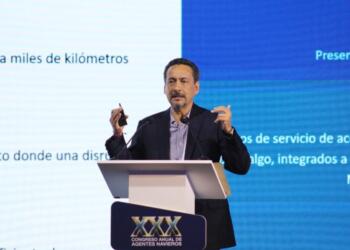
The Mexican Association of Freight Forwarders (Amacarga) believes that Mexico, the United States, and Canada must move towards interoperable digital corridors to protect the integrity of the entire logistics operation.
The organization indicated that Mexico should not wait to learn about the upcoming requirements stemming from the review of the United States-Mexico-Canada Agreement (USMCA) to strengthen its competitiveness, but can instead come up with its own proposal based on greater traceability, advance information, reliable operators, digitalization, regulatory compliance and supply chain integrity.
“North America’s next competitive advantage will be trust, and that can only be built with secure, predictable, and resilient supply chains,” Amacarga stated.
As part of the various forums, working groups and workshops that Amacarga has developed over the last few years with national and international authorities on supply chain security, the association has promoted the strengthening of electronic transmissions as a strategic tool for risk management .
In this regard, General Rules 1.9.9 (maritime transport) and 1.9.15 (air transport) establish the advance transmission of information by freight forwarders, which allows for traceability of operations and provides timely data that, when used by the competent authorities, strengthens risk analysis, intelligent selection of inspections, and the prevention of illicit use of logistics chains.
“For Amacarga, the security of international trade no longer depends solely on increasing inspections, but on leveraging advance information to transform it into intelligence that allows for better decision-making. Strengthening electronic transmissions represents an opportunity to promote safer, more efficient, and more competitive trade, consolidating Mexico as a reliable partner within North America,” he emphasized.
North America generates enormous amounts of logistics information daily: HBL (a legal document that serves as a receipt for the goods and a contract of carriage), HAWB (a bill of lading that functions as a contract and receipt between the freight forwarder and the shipper), manifests, invoices, certificates, customs declarations, routes, carriers, importers, exporters, and records of operations. “The challenge is no longer just generating this data, but transforming it into intelligence,” he emphasized.
The eBL (digital version of the traditional bill of lading), the e-AWB (electronic document that functions as a transport contract between the shipper and the carrier), electronic certificates and advance information can allow you to know about a transaction before the goods reach the border.
Blockchain or artificial intelligence can be incorporated when they truly generate value, but they shouldn’t become the goal. “The goal isn’t the technology. The goal is trust,” he asserted.
The agency mentioned that better information would also allow for a change in the logic of customs control , “not necessarily inspecting more, but checking less and checking better, concentrating resources on those operations that present the greatest risk.”
“That could be one of the great bets of the USMCA review, not only to trade more within North America, but to build together the most reliable region in the world to produce, transport and trade goods,” he noted.
Amacarga indicated that the Mexican government can come up with its own proposal based on greater traceability, advance information, reliable operators, digitalization, regulatory compliance and supply chain integrity.
Comment and follow us on LinkedIn: @GrupoT21