The operational relationship between Hapag-Lloyd and AP Moller-Maersk , established through the Gemini Cooperation, will take another step forward on land. Hapag-Lloyd has agreed to acquire a 25% stake in APM Terminals Maasvlakte II BV , in the Port of Rotterdam. This transaction aims to support the expansion of capacity and the performance of a terminal that has become a key component of Hapag-Lloyd’s European network.
The agreement will allow Hapag-Lloyd to secure long-term automated container handling capacity at Maasvlakte II, while strengthening its presence in port infrastructure through Hanseatic Global Terminals (HGT) , its Terminals and Infrastructure division. APM Terminals will retain operational control of the facility.
The operation takes on particular significance due to Maasvlakte II’s role within Gemini , the collaboration between Hapag-Lloyd and Maersk that aims to create a highly reliable maritime network. In this framework, port capacity and efficiency at connecting nodes are essential for sustaining routes and accommodating future cargo increases.
“With the planned investment in Rotterdam, we will further improve the efficiency and reliability of our network. The terminal is a key element of the Gemini Cooperation and fits well with our strategy to build a stronger terminal portfolio in core markets,” said Dheeraj Bhatia, CTIO of Hapag-Lloyd AG and CEO of Hanseatic Global Terminals.
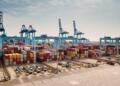
Hapag-Lloyd’s entry also coincides with Maasvlakte II undergoing an infrastructure expansion that will significantly alter its operational scale. The terminal, operational since 2015, will add 1,000 meters of deep-water berthing space, doubling its total to 2,000 meters.
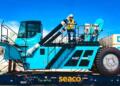
The project also includes increased yard capacity, four additional rail tracks, and the deployment of automated terminal tractors (ATTs), along with other automated equipment. Once the new configuration is complete, Maasvlakte II will have a projected annual capacity of 5.4 million twenty-foot equivalent units (TEUs) .
The expansion not only aims to absorb larger volumes, but also to increase the resilience of the operation and prepare the terminal for future cargo flows through Rotterdam, one of the main entry and exit points for containerized trade in Europe.
Keith Svendsen, CEO of APM Terminals, noted that Hapag-Lloyd’s stake represents “a strong vote of confidence in a terminal that is fundamental to the Gemini network and to Rotterdam ,” while also highlighting that the transaction reflects the collaboration between the two companies and their commitment to the long-term development of the asset.
The expansion, he explained, is being developed through the coordination of the Maasvlakte II team, the company council and the Rotterdam Port Authority, while APM Terminals will continue as the facility operator .
“Our ambition is to make Maasvlakte II the best terminal in Northern Europe for every customer who calls on us. That means improving safety, quality, delivery, and cost, in that order, while expanding deep-water berths and TEU capacity to support customer growth for decades to come,” said Svendsen.
For Hapag-Lloyd, the transaction also deepens a strategy that extends beyond maritime transport. Through HGT, the shipping company has been building a portfolio of terminals and infrastructure with the aim of securing positions at strategic hubs and increasing its capacity to integrate its maritime operations with land-based cargo interchange points.
In Maasvlakte II, this strategy aligns with the need to secure long-term port capacity for Gemini. The combination of new berths, automation, a larger operational area , and rail connections will expand container handling capacity and strengthen Rotterdam’s role within the network.
APM Terminals and Hapag-Lloyd did not disclose the financial value of the acquisition of the 25% stake. The transaction still requires approval from the relevant authorities and regulatory bodies before completion.
Comment and follow us on LinkedIn: @GrupoT21