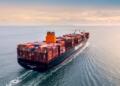
The Panama Canal will again reduce the draft allowed for Neopanamax vessels as part of a strategy to manage its water reserves without, for now, compromising the daily flow of ships. The decision will require some shipping companies to adjust the cargo carried by their vessels, although the canal authority will maintain the number of authorized transits unchanged, in a context where the interoceanic waterway continues to increase its activity and is preparing new measures to address a potential El Niño phenomenon.
The Panama Canal Authority informed shipping lines that the maximum draft allowed in the Neopanamax locks will be 48 feet (14.63 meters) starting August 26 and will decrease to 47.5 feet (14.48 meters) from September 3.
Although the reduction may seem marginal, draft is one of the main operational parameters for navigation, as it determines the depth at which a vessel can safely transit and, consequently, the amount of cargo it can carry during its voyage. In practice, less available depth may force vessels to cross with less weight to comply with the restrictions established by the interoceanic waterway.
The measure responds to the current behavior of Lake Gatun and the hydrological projections for the coming weeks, variables that continue to be crucial for the operation of the Canal because this reservoir is the main source of water used in the operation of the locks.
Unlike the restrictions implemented during the water crisis of 2023-2024, the new adjustment does not include changes to the number of daily transits . The canal administration’s strategy is to preserve the continuity of operations through more efficient water resource management rather than reducing the waterway’s capacity.
The restrictions are part of water conservation measures that began to be implemented in December 2025 in preparation for the 2026 dry season. Since then, the Canal has been gradually adjusting its operating parameters as hydrological conditions evolve .
With the announcements made for August and September, the interoceanic waterway will accumulate four and five draft adjustments within the current operational management program, a strategy based on the permanent analysis of reservoir levels, historical records and hydrological projection models that allow anticipating scenarios of lower water availability.
The experience gained during the 2023-2024 drought redefined how the Canal manages water risk. The restrictions that affected both the number of transits and navigation conditions led to strengthening monitoring systems and operational planning to more accurately anticipate potential water scarcity scenarios.
More transits and greater tonnage
The operational adjustments come at a time of growth for the interoceanic waterway. At the close of the third quarter of Fiscal Year 2026, corresponding to the period from October 2025 to June 2026, the Panama Canal registered an average of 35 transits per day and a total of 10,726 crossings, a figure higher than the 10,191 registered during the same period of the previous fiscal year.
This dynamism was also reflected in the volume of cargo handled. During the first nine months of the fiscal year, the Canal transported 389.96 million tons CP/SUAB , representing a 7.2% year-on-year increase, driven primarily by the transit of container ships and vessels dedicated to the transport of Liquefied Petroleum Gas (LPG).
The operational growth was accompanied by an improvement in financial results. Between October 2025 and June 2026, transit revenues reached $4.802 billion , a 17% increase compared to the same period of the previous year, while profits amounted to $3.614 billion, equivalent to an annual growth of 19%.
This performance has also allowed progress in projects aimed at strengthening the Canal’s long-term competitiveness, including new port terminals, a gas pipeline and the development of the Indio River reservoir , infrastructure with which it seeks to expand its operational capacity, diversify logistics services and reinforce the availability of water for the coming decades.
Despite these results, the Panama Canal Authority is continuously monitoring weather conditions and the evolution of the El Niño phenomenon, whose likelihood of developing has increased in the coming months. Based on these analyses, the Canal will continue to adjust its operating parameters as needed to preserve the reliability of this strategic infrastructure for international maritime trade and reduce the impact of climate variations on global supply chains.
Comment and follow us on LinkedIn: @GrupoT21