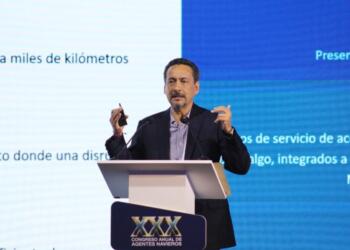
“We are providing the services as part of the logistics carried out by the teams that will be here in Mexico,” María Guadalupe Mancera Pérez, the company’s general director, told T21.
The operation includes torton -type units intended exclusively for the transfer of luggage and materials from airports to hotels and stadiums, as well as the subsequent return movement to the airport once the teams’ participation is over.
“These units receive the luggage and materials brought by the teams, transport them from the airport to the hotel, from the hotel to the different stadiums, return them, and then, after a month and a half, return them to the airport,” Mancera Pérez explained.
The company will allocate 10 units for this operation : three in Guadalajara, three in Monterrey, three in Mexico City, and one more in Cancun.
In addition to the transfer of luggage and uniforms, Tresguerras is already participating in coordination meetings with the International Federation of Association Football (FIFA) to learn about the operational restrictions that will exist during the matches and the controlled access around stadiums and concentration areas.
Mancera Pérez explained that the company has already identified the need to adapt its last-mile deliveries in light of road closures and restricted perimeters that will remain active even throughout the day on game days.
Logistics planning also takes into account possible impacts from traffic and massive concentrations of people in the vicinity of stadiums , so Tresguerras plans to reinforce its operational capacity by renting additional units if daily delivery productivity decreases.
“We also plan that if at any point, precisely because of the crowds or the excess traffic and the restrictions of zones, the average number of deliveries drops, we have planned to rent additional equipment,” he explained.
Mancera indicated that prior experience with large-scale events was one of the factors that allowed the company to be considered for the World Cup logistics . Among that experience, he mentioned transportation related to music tours, exhibitions, and other high-profile mass events.
“We have practically moved the high-level events ourselves. So, that’s where the recommendation to FIFA comes from,” he stated.
According to the directive, the approach was made through organizers with whom the company had previously worked on special operations.
Currently, Tresguerras operates a fleet of 3,400 highway trucks (more than 90% tractor-trailers) and around 1,200 last-mile units, in addition to a network of 214 terminals in the country.
Comment and follow us on LinkedIn: @Karina Quintero / @GrupoT21