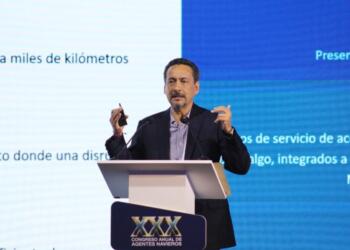
The economic slowdown , uncertainty surrounding tariffs , and cautious investment continue to shape the trucking industry in Mexico. Even so, Autotransportes de Carga Tresguerras reported a start to 2026 with double-digit growth and better expectations than last year.
Jorge Enrique Almanza Mosqueda, president of the company’s board, acknowledged that 2025 was a difficult year for the sector , after the trucking industry grew by only 0.5%, according to figures from the National Institute of Statistics and Geography (Inegi) .
“How can we grow if our customers don’t grow, don’t sell more, and don’t ship more?” the executive asked, speaking about the impact that economic uncertainty and tariff threats have had on investments and the movement of goods.
Despite this outlook, Almanza assured that the company managed to close last year with a real growth of 2.5% , discounting inflation, and that for 2026 the prospects look more favorable , although still far from the dynamism that the sector would expect.
“The year hasn’t started badly for us; it’s started better than last year. We’re seeing growth of just over 10%,” he commented.
The executive explained that, given the current environment, the company adjusted its expansion expectations. While Tresguerras historically maintained growth rates of around 10% annually in units, this year they decided to project 5% growth.
Even so, María Guadalupe Mancera Pérez, general director of Autotransportes de Carga Tresguerras, pointed out that the company maintains an accumulated growth of 14% , although below the 17% initially budgeted for 2026.
“It is still possible that it will improve significantly because our highest demand is in the last four months,” Mancera explained.
For Tresguerras, one of the key factors in maintaining competitiveness in a pressured market has been the quality of service. Almanza Mosqueda explained that the company has been working on quality processes for over 30 years and has maintained ISO 9001 certifications since 2001.
The Chairman of the Board indicated that the company has also strengthened its infrastructure, expanding terminals, renewing its fleet, and developing its own technology for operation and monitoring.
Tresguerras currently operates a fleet of 3,400 highway trucks (over 90% tractor-trailers) and 1,200 last-mile delivery vehicles. It also has 214 terminals across the country, with a virtually nationwide presence.
Almanza Mosqueda highlighted that the company maintains one of the fleets with the lowest average age in the industry, close to three years.
In parallel, Mancera Pérez added that the company has strengthened technological areas focused on artificial intelligence, data science, and real-time visibility for customers, seeking to offer greater traceability and security in operations.
The executive noted that one of the elements most valued by customers today is the ability to monitor cargo in real time and ensure shipment safety.