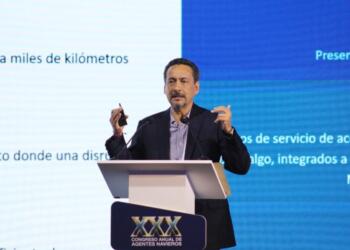
In a logistics environment marked by structural adjustments and expectations of reactivation, Schneider is positioning itself as one of the players seeking to capitalize on intermodal transport in North America, especially in the cross-border corridor between Mexico and the United States .
The industry is facing a process of structural rationalization of supply, particularly in the United States, where the market is experiencing adjustments in available capacity , says Michael Baumgardt, senior vice president of Intermodal at Schneider.
“We are seeing a structural change in the supply. I don’t think we are at the end of this process yet, but it has clearly begun to gain momentum,” Baumgardt elaborates.
In this regard, he explains that while demand has remained relatively stable, the main focus for logistics operators is on available capacity, as after several years of adjustments, they are facing new market scenarios. Therefore, companies’ ability to react will be crucial in the event of a surge in demand , a scenario that could translate into greater operational demands and growth opportunities.
It mentions that one of the main challenges for 2026 is responding to an environment where shippers will need greater flexibility and multimodal solutions that reduce operational risks. Furthermore, customers are increasingly seeking reliable services with competitive transit times and high levels of security, without having to sacrifice efficiency compared to traditional trucking.

In that context, he argues that intermodal transport is beginning to gain ground among companies that have historically relied solely on road transport.
“Today there are many opportunities for customers to integrate intermodal as a complement to existing transport networks, especially considering the structural capacity challenges we see in the market,” he adds.
Currently, Schneider combines intermodal operations with land freight capabilities and logistics services, allowing customers to integrate different modes of transport within the same network.
One of the key projects in this evolution has been the development of the Midwest Mexico Express (MMX) corridor , driven in conjunction with Canadian Pacific Kansas City (CPKC) . Almost two years after its implementation, Baumgardt notes that the service has generated interest among various shippers thanks to its speed and operational consistency.

“We were looking for a direct service that would allow us to reduce transit times, and CPKC offers expedited service combined with Schneider’s capacity, which has enabled us to offer a differentiated service focused on improving reliability and operational efficiency. Furthermore, intermodal transport is generally more fuel-efficient than long-distance trucking,” says Bernardo Rodarte, Vice President and General Manager of Schneider Mexico.
By Evangelina del Toro and Jennifer Galindo.
Comment and follow us on LinkedIn: @Evangelina del Toro / @Jennifer Galindo / @GrupoT21