In a context where geopolitical tensions, the review of the United States-Mexico-Canada Agreement (USMCA) and structural changes in supply chains have tested the resilience of companies, the 2026 edition of the Logistics Pulse marks a turning point: leaving measurement behind to focus on action .
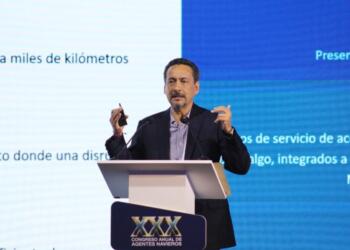
During the presentation of the study, Ángel Estrada, managing director of Alvarez & Marsal , highlighted that this new edition responds to a different reality, in which the challenges of the past have evolved into structural challenges that require strategic decisions.
“In previous years we measured efficiency, costs and performance. Today the focus is on looking ahead and understanding what’s coming and how to act,” he noted at The Logistics World Summit & Expo.
 Unlike previous editions, the 2026 Pulse Meter was built from more than 45 interviews with leaders of the logistics ecosystem , including companies, operators, associations, academia and government, with the aim of identifying trends and defining courses of action in seven key pillars, such as infrastructure, costs, resilience, technology, security, talent and sector collaboration.
This change in methodology reflects an evolution of the sector, which has gone through different stages in recent years, from the disruption caused by the COVID-19 pandemic, to the container crisis, energy volatility and, more recently, the regionalization of supply chains .
In this context, Estrada stressed that 2026 is a critical year for Mexico, particularly due to the review of the USMCA and international pressure to strengthen regional integration.
One of the main findings of the study is that Mexico has a real opportunity to consolidate itself as a logistics hub in Latin America , driven by nearshoring and the global reconfiguration of trade.
However, this opportunity coexists with structural tensions that go beyond logistical costs, such as insufficient infrastructure, security challenges, and a lack of specialized talent.
“We are at a pivotal moment. There is a great opportunity, but also pressures that, if not addressed, could become bottlenecks,” Estrada warned.
One of the most significant changes identified is the transformation of the role of logistics within companies. From being an operational function focused on costs, it is evolving into a strategic element in decision-making.
“Logistics is being discussed in the council today. It is a growth enabler and a competitive advantage,” Estrada explained.
This change responds to the need to build more resilient, efficient supply chains that are aligned with business objectives.
The study also highlights two critical factors: talent and technology .
On the one hand, a lack of specialized skills can limit the sector’s growth. On the other hand, the accelerated adoption of technologies like artificial intelligence (AI) opens up opportunities, but also risks if not implemented in a structured way.
“Many solutions arrive as isolated applications, without being integrated into the processes. The challenge is to connect end-to-end and start from clean data,” Estrada pointed out.
Security and infrastructure, the structural issues to be resolved
During the press conference, leaders in the logistics sector agreed that the main challenges remain security and infrastructure.
Hugo Ruiz, president of the National Council of Executives in Logistics and Supply Chain (ConaLog) , highlighted that there is a growing recognition, even from the government, of the deficiencies in infrastructure.
“It’s something that wasn’t openly discussed before. Today there’s agreement between the public and private sectors, and it’s one of the issues we need to resolve in the coming years,” he stated.
Regarding security, Sandra Aragonez, senior director at Alvarez & Marsal , stressed that it must cease to be an operational issue and become a strategic focus within organizations.
“Security must be on the same level as supply chain management. It must be integrated from the operational design stage,” he stated.
From conversation to execution
One of the most compelling calls of the 2026 Pulse Meter is the need to move from diagnosis to action.
Bernardo Flores, from Alvarez & Marsal , emphasized that the real challenge is to translate opportunities into concrete results, through collaboration between companies, government and academia .
For his part, Juan Carlos Molina, general director of GS1 Mexico , stressed that digitalization will be key, as long as it is supported by standards that allow for efficient communication.
The message is that the moment demands coordinated action. For Juan Pablo Pacheco, managing director of HAF Logística Internacional , the key lies in collaboration among stakeholders.
“We need to work together as a sector to solve the challenges,” he said.
The participants agreed that, although Mexico has managed to grow despite its limitations, its true potential will be reached when structural problems are addressed.
“Imagine what we could achieve if we resolve these deficiencies,” Ruiz said.
Comment and follow us on LinkedIn: @Jennifer Galindo / @GrupoT21