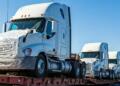
The heavy vehicle industry in Mexico maintains expectations of a gradual recovery during the second half of 2026, although the sector acknowledged that it still faces an environment marked by economic slowdown , trade uncertainty with the United States and pressure from imports of used units.
During the monthly industry results press conference, Guillermo Rosales, executive president of the Mexican Association of Automotive Distributors (AMDA) , explained that the decline in the domestic market is due to a combination of internal and external factors.
Among them, he pointed to the slower economic growth, the uncertainty surrounding the review of the United States-Mexico-Canada Agreement (USMCA) , and the saturation of the secondary market resulting from the influx of used vehicles from the United States.
“To this we must add the uncertainty surrounding the trade relationship with the United States, the renegotiation process, and the review process that the USMCA is currently undergoing,” Rosales commented.
The executive added that the importation of used trucks continues to affect the profitability of the sector and distort the national market due to tax evasion and avoidance practices.
According to Rosales, domestic sales of heavy vehicles closed 2025 with a drop of 32% and, at the end of the first four months of 2026, maintain a decrease of close to 29% (with nine thousand 845 units placed).
Despite this, he maintained that the sector expects a gradual recovery during the coming months , driven by measures implemented together with the federal government to encourage vehicle renewal.
Among the actions mentioned were support programs to facilitate the acquisition of new units, including schemes that allow amortizing up to 85% of the cost of a truck in a single fiscal year, in addition to credit guarantees backed by Nacional Financiera (Nafin) .
“We expect that in the following months from now until December we will recover ground,” said Rosales, who indicated that the sector’s expectation is to close 2026 with a slight growth of 1% compared to 2025.
However, he acknowledged that even reaching that favorable scenario, the industry would still be far from the record levels recorded in 2024.
For his part, Alejandro Osorio, director of Public Affairs and Communication of the National Association of Bus, Truck and Tractor-Trailer Producers (ANPACT) , highlighted that the immediate attention program announced by the federal government seeks to revitalize the domestic market and accelerate fleet renewal, particularly among owner-operators and micro and small transport companies.
The executive stressed that modernizing the fleet is key to increasing the competitiveness of the trucking industry and the national economy, noting that approximately 86% of goods in Mexico are transported by road.
Furthermore, he warned that the sector faces accelerated growth in imports of vehicles and components from China , a situation which, he said, presents challenges for national suppliers and for value creation in Mexico.
Osorio pointed out that, in addition to curbing the importation of used vehicles from the United States, it is also necessary to strengthen customs supervision and compliance with official Mexican standards regarding safety, emissions, and technical performance.
At the same time, he acknowledged that the market downturn has impacted employment in the industry. He explained that approximately 20% of the production workforce lost jobs following the slowdown in the sector.
“It is essential that, in addition to productivity and maintaining investment conditions, employment is also maintained,” he said.
Comment and follow us on LinkedIn: @Karina Quintero / @GrupoT21