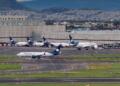




Finally, I got to fly on Mexicana , that is, on the militarized airline that bought the name of the original Mexicana (Compañía Mexicana de Aviación-CMA), where I once worked and where I made about 250 flights as a passenger, most of them on board their beautiful Boeing 727s.
I recently mentioned in this same space how, when planning a plane trip with my partner, she flat-out told me that, given the distrust she felt about how she perceived things were being handled by the federal government, she would under no circumstances accept that the transfers be on board Mexicana aircraft, a wish that I initially decided to grant.
However, as the saying goes, “Money talks,” and when we confirmed the fare differences between Mexicana and its competitors, which were up to three times higher than those of the state-owned airline run by the Ministry of National Defense , things changed, and my colleague finally agreed to board an Embraer from that operator to and from the “Felipe Ángeles” International Airport (AIFA) , a terminal that, like so many Mexicans annoyed with the Morena party, she had literally banned.
The question is unavoidable:
How did we fare under the 4T?
I won’t deny that, 16 years after CMA’s last flight, it feels strange to suddenly find myself with a boarding pass for a trip on an aircraft decorated with its brands, slogans, colors, uniforms, and logos. While at first glance one might feel served by a kind of continuation of the original, the truth is that the current “Mexicana,” however much they try to sell it to us as such, is far from being that great school of Mexican air transport that we remember so fondly. The Mexican state airline, which is trying to emulate CMA, treats its crews the same way militarized civilian companies manage their employees, whether in combat uniform or not. In other words, it applies policies typical of military management, where best administrative and operational practices, and even labor and human rights, take a back seat to orders from high command. Like it or not, this is a reality that deserves analysis. This installment focuses on the quality of its service and, by extension, the quality of the airports we use. Let’s see:
A first and, I must say, pleasant surprise that I had beyond the issue of fares, is that when, as a good “veteran,” I decided to try to buy the tickets by calling Mexicana directly, the interaction reminded me of the now ancient times when acquiring an airline ticket was a matter of a brief call to their reservations center or visiting a travel agency and not the nightmare of having to deal with “call centers” and their overprices and charges of other airlines. It took a very kind and efficient Mexicana representative no more than 15 minutes to quote and sell me the tickets at an even lower price than what was published on their website, since she had the sensitivity to detect that her passengers were senior citizens and therefore could offer them a special INAPAM fare that unfortunately did not allow online check-in but directly at counters in the airport, which meant that I was not able to receive the toll waiver on the Circuito Exterior Mexiquense on my “outbound” trip that is offered to passengers using the AIFA, showing their boarding pass, which added about 500 pesos to the cost of the trip.
Perhaps resigned, my partner was receptive to experiencing AIFA , confirming that it is indeed a large airport—I reiterate, one that should never have been built—but that now that it’s operational and offers great comfort, although I must point out, and this worries me, that it’s beginning to show various signs of deterioration in its facilities and equipment . Something we loved once on the plane was its new appearance, its configuration with rows of four seats that avoid that horrendous “middle seat,” its comfort, and the generous legroom.
The magic of air travel ended at our destination: Chetumal Airport, operated by Grupo Maya, also military-owned, which I can only describe as a virtual barracks, operating with the corresponding associated overcharges, where poor service and numerous violations of the Chicago Convention on International Civil Aviation , its annexes and certain standards in the provision of commercial services to passengers are the norm, compromising the perception of quality in the experience, including that of Mexicana, whose staff at that station is far from matching the staff who served us at the reservations center, the AIFA, already on board the planes.
Speaking of Chetumal, it would seem unfair not to praise the beauty of its tourist attractions, starting with its beautiful boardwalk, its gastronomy and its nearby Bacalar Lagoon, a true, affordable and magical natural paradise in a troubled Quintana Roo that, locals tell me, deserves better government management.
In the end…
The truth is that I’ve already recorded a couple of takeoffs and landings on board the new militarized airline in my passenger logbook, and therefore, another inevitable question arises:
Would you repeat the experience?
Very possibly, yes, especially considering the purchasing process, the fares and their terms , the aircraft interiors, the in-flight service, and punctuality. And to think that one of the many military officers who have been put in charge of that company, when I suggested it to him as part of his team during its early days, told me that service quality couldn’t be a competitive advantage for the operator because, according to him, it can’t be measured!
There’s no way to help these gentlemen who have tried to transition from a military barracks to the office of a civilian business, making many mistakes and failing to consider that “Peje’s” idea to rescue the Mexicana brand and give it to a new government airline, whose sustainability hasn’t been properly planned or demonstrated, is costing us dearly. That, dear reader, is the price I, as a Mexican taxpayer, actually paid for my ticket on that airline.
So I helped the public treasury continue to subsidize it?
Possibly! But it is also true that, as things stand, the so-called 4T will not have the humility to recognize its mistake, not only in building the AIFA, but also in putting the military in charge of certain airports and creating a new airline to have flights in them, and they will not rectify it. Furthermore, the flights we boarded were going to take place with or without us on them, so I feel we had the right to take advantage of them. In my case, it was also to have objective information to discuss this airline, which I have already confessed I unfortunately see as a significant factor in the Mexican air transport supply once Viva and Volaris merge. I say unfortunately because it’s clear to me that it will be very difficult for Mexicana to stop losing money someday, even if it continues to grow. This is due, among other reasons, to the opportunities that Mexican antitrust authorities will present when they evaluate and condition the shareholding and operational integration proposed by the airlines of Roberto Alcántara and Enrique Beltranena . This leads me to believe that the best thing that could happen for Mexico is for the federal government to decide to eliminate it.
As I’ve stated before, of all the costly projects of the current administration, the airline, being a business and not infrastructure, seems to me the easiest to shut down, thus reducing, even if only slightly, the pressure on the country’s government finances stemming from these unjustifiable subsidies. But I insist, that’s not going to happen, at least not while Morena continues to champion the disastrous legacy of its founder, while voters remain unaware that they’ve been deceived and harmed, and while the military continues to play at using our taxes for political gain.
Comment and follow us on LinkedIn: @GrupoT21