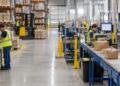
For years, the design of warehouses and distribution centers followed a simple logic: receive goods, consolidate them, and keep them available until needed. However, the shift in the location of manufacturing operations and the pressure on logistics costs are leading companies to rethink that structure.
In an interview with T21, Wilbert Barrera, a consultant in Storage Systems Engineering for the northern region at PM STEELE , recalled that previously the focus was on finding lower investment costs, while today companies need to integrate production and logistics processes closer to their consumer markets .
“Before, everything was based on what is commonly called offshoring, or seeking the minimum investment within warehouses in the national territory because almost everything was concentrated in companies from other places, for example in Asia, where labor was much cheaper,” Barrera explained.
The relocation of production lines, known as nearshoring , has contributed to changing this dynamic. In Nuevo León, he explained, the arrival and expansion of manufacturing companies are driving demand for industrial infrastructure, while established companies are looking to adapt their facilities to handle larger volumes and respond more quickly .
Barrera said that companies are seeking to integrate a supply chain that encompasses everything from raw material procurement to finished product assembly, with a location that facilitates distribution to the United States. In this framework, connectivity with Texas has become increasingly important due to its highway network and its access to various markets across the country.
The need to reduce exposure to disruptions also influences decisions. The specialist cited as an example that weather events in Asia can delay the supply of components and affect manufacturing times. In response, some companies have opted to bolster their inventories and relocate some of their operations closer to production and consumption points .
According to the second edition of the “BBVA Mexico-AMPIP Survey ,” members of the Mexican Association of Private Industrial Parks (AMPIP) reported that between 2018 and 2022 they received 668 new tenants in their industrial parks, an average of 134 companies per year. This data reflects a search for closer supply chains.
This growth puts pressure on storage infrastructure. The demand for industrial space and rising rental costs make it more difficult to maintain multiple warehouses with fragmented operations.
“You can no longer afford to have two, three, or four warehouses that are consuming your rental costs,” explained Barrera, who believes that organizations should review both their facilities and the movements between them.
From their perspective, the warehouse should no longer be viewed as a flat surface but understood as a three-dimensional space . The goal is to take advantage of vertical space, reduce travel distances, and organize inventory according to its turnover rate, without losing sight of safety and operational speed.
To achieve this, the first step is understanding how each facility operates. Barrera explained that a consultancy should review product traceability, maximum and minimum inventory levels, ABC classification, and the frequency with which each storage unit is moved . With this information, workflows can be designed to meet the needs of each operation, from a distribution center to a cold chain facility or e-commerce platform.
“Many times people think that designing a storage system is like prescribing paracetamol, that the same solution applies to everything you want to give, and that’s not really the case,” he stressed, while mentioning that the selection of the system depends on the type of merchandise, the turnover, the order preparation times and the operating conditions of each company.
In this process, semi-automated systems are gaining ground. The specialist highlighted satellite carts or shuttles , which move pallets within the racks and reduce the need for forklifts to enter the storage aisles. According to the executive, this equipment can speed up movements and help reduce operational risks, as well as avoid adding extra shifts when demand increases.
Digitalization complements physical equipment. Warehouse management systems (WMS) allow for the registration and tracking of products, while integration with automated equipment facilitates the coordination of merchandise movements. In this regard, he emphasized that the transformation also requires training personnel and modifying how operations are managed, not just installing technology.
Another trend is the design of hybrid warehouses , which combine high-density systems for fast-moving products with selective pallet racking for goods that need to be readily accessible, and dedicated areas for order picking. Robotic picking solutions are also being incorporated into some e-commerce operations. The goal is to consolidate more activities in one facility and reduce movement between different locations.
Investment in technology, however, coexists with trade uncertainty. Barrera noted that some storage projects were halted due to concerns about tariffs, particularly in sectors linked to the automotive and aluminum supply chains; however, he stated that they have now fully resumed.
How large companies are redesigning their supply chains will be one of the topics addressed at ETYL MTY , organized by Grupo T21 , where specialists such as Hugo Ruiz , president of the National Council of Executives in Logistics and Supply Chain (ConaLog) ; Jorge Fares , Supply Chain Development Sr. Director at The Home Depot ; Claudia Núñez , VP Supply Chain at Essity , among others, will participate.
Comment and follow us on LinkedIn: @Humberto Cruz Moya / @GrupoT21