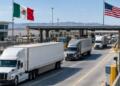
Merchandise trade between Mexico and the United States is expanding. During June 2026, bilateral trade reached $89.2 billion , a 22.2% increase compared to the same month in 2025, with trucking being the primary mode of transportation, reported the Bureau of Transportation Statistics (BTS) .
Behind these growth figures, however, lies a border under increasing pressure: more trucks, larger cargo volumes, and an infrastructure that must respond to the accelerated pace of supply chains.
The US agency detailed that during the period, $68.5 billion worth of goods were moved between the two countries via trucks ; while $8.5 billion was transported year-over-year by rail.

Laredo, El Paso, and Otay Mesa are the main ports of entry for trucking to and from Mexico . Meanwhile, Laredo, Eagle Pass, and El Paso are the main ports of entry for rail freight, according to BTS.
Danae Vilchis Hernández, a research specialist in economic engineering and transportation systems at the Coordination of Economic and Social Studies of Transportation of the Mexican Transportation Institute (IMT) , recalled that in 2025, road transport between both countries accounted for 68% of exports and 77% of imports.
“International trade now depends on a land network; however, it is important to recognize that it is not about transferring everything to rail, but rather that it has to be complementary, so we have to focus on the points where we can make a connection with the rail, road and maritime network,” he said.
He mentioned that trade between Mexico and the United States reached over 16.8 trillion pesos in 2025, including both exports and imports , representing a substantial share of total Mexican foreign trade. This solidifies Mexico’s position as the United States’ main trading partner and highlights the strategic importance of border road and rail infrastructure for national competitiveness . This modal structure reflects the importance of land border infrastructure, particularly at the northern crossings, where the majority of trade flows are concentrated.

In the seminar “Statistics of transport of foreign trade between Mexico and the United States” , the specialist indicated that currently the Mexico-Laredo, Mazatlán-Matamoros, Querétaro-Ciudad Juárez, Mexico-Nogales, Manzanillo-Tampico and Veracruz-Monterrey corridors are among the most saturated .
“Here we can identify the corridors where we have high congestion and where we would require the implementation of alternative routes. This dependence on the corridors represents a major problem for us in terms of congestion; if any of them have capacity issues or accidents, this affects our global supply chains,” he emphasized.
Among the challenges that currently exist in the handling of goods, he considered that physical inspection continues to be a bottleneck, despite having a better time to carry out this activity.
“While we already have very fast customs release times and customs inspection times that are perhaps already competitive internationally, there is still a bottleneck in physical inspection,” he said.
The bottlenecks of binational trade and the pressure of nearshoring (relocation of production lines) on the border will be one of the topics addressed during ETYL MTY , which will take place on October 14 and 15 at the Presidente InterContinental Hotel in Monterrey, Nuevo León .
The event, organized by Grupo T21 , will feature the panel “Saturated Borders: The Critical Challenge of Mexico-United States Trade ,” with the participation of Luis Hernández, Executive Vice President of Intermodal at Grupo México Transportes (GMXT) ; Adrián González, President of Global Alliance Solutions , among other prominent specialists in the logistics sector.
Learn more about the event and register here .
Comment and follow us on LinkedIn: @Evangelina del Toro / @GrupoT21