In its report for the second quarter of 2026 (2Q26) on cargo theft in Mexico, Overhaul revealed that, although there was a composition in the events recorded in the central and southeastern zones , when considering both regions, they remain the ones with the highest generation of incidents for the activity.
The central and southeastern zone accounted for 77.6% of total robberies , which translates into an increase of 0.8 percentage points (pp) in the joint participation, when compared to the same cycle in 2025.
Another quadrant with a significant role in cargo theft is the Bajío region, which accounted for 17.9% of criminal activity , representing an increase of 2.4 percentage points compared to the second quarter of 2025.
Thefts by region (%)
The Overhaul report identifies the participation that each region had in the total number of incidents in the motor transport industry.
Quarterly Comparison (Q3 vs. Q2 2025)
-
Center: 54% (Q3) | 46% (Q2 2025)
-
West: 26% (Q3) | 31% (Q2 2025)
-
Northeast: 10% (Q3) | 11% (Q2 2025)
-
Northwest: 7% (Q3) | 10% (Q2 2025)
-
Southeast: 3% (Q3) | 2% (Q2 2025)
Regarding state activity, the largest movements were recorded in Guanajuato, where it increased by 2.4 pp, San Luis Potosí with 22.2 pp, Veracruz +2.1 pp, Jalisco +0.9 pp, Tlaxcala with 0.6 pp and Michoacán with +0.2 pp.
In contrast, the states that showed a contraction were Puebla with -5.5 pp, State of Mexico with -2.0 pp, Hidalgo with -0.8 pp and Querétaro with -0.6 pp.
In the temporal analysis, Thursdays showed the highest incidence rate at 22%; while by time of day, the night (6:00 PM to midnight) was the period of greatest risk with 31% of the incidents. The most concentrated peak times occurred from 3:00 AM to 7:00 AM (25%) and from 6:00 PM to 10:00 PM (27%).
The main modus operandi recorded in Mexico during Q2 2026 was the interception of vehicles in transit, representing 58.8% of cases (a decrease of 6.2 percentage points compared to Q2 2025). Theft of parked vehicles was the second most common modality, accounting for 39.3% of incidents (+5.3 percentage points compared to Q2 2025).
Thefts by entity
Accident rate records for the main states of the country, showing the change between 2025 and 2026, in both cases for Q2.
State Breakdown (Q2 2025 vs. Q2 2026)
-
State of Mexico: 20% (Q2 2025) | 18% (Q2 2026)
-
Puebla: 23.5% (Q2 2025) | 17.9% (Q2 2026)
-
Guanajuato: 8.3% (Q2 2025) | 10.8% (Q2 2026)
-
Veracruz: 5.3% (Q2 2025) | 7.4% (Q2 2026)
-
San Luis Potosí: 5% (Q2 2025) | 7.2% (Q2 2026)
-
Jalisco: 6% (Q2 2025) | 6.9% (Q2 2026)
-
Michoacán: 6.3% (Q2 2025) | 6.5% (Q2 2026)
-
Hidalgo: 5.3% (Q2 2025) | 4.6% (Q2 2026)
-
Querétaro: 4.3% (Q2 2025) | 3.8% (Q2 2026)
-
Tlaxcala: 2.5% (Q2 2025) | 3.1% (Q2 2026)
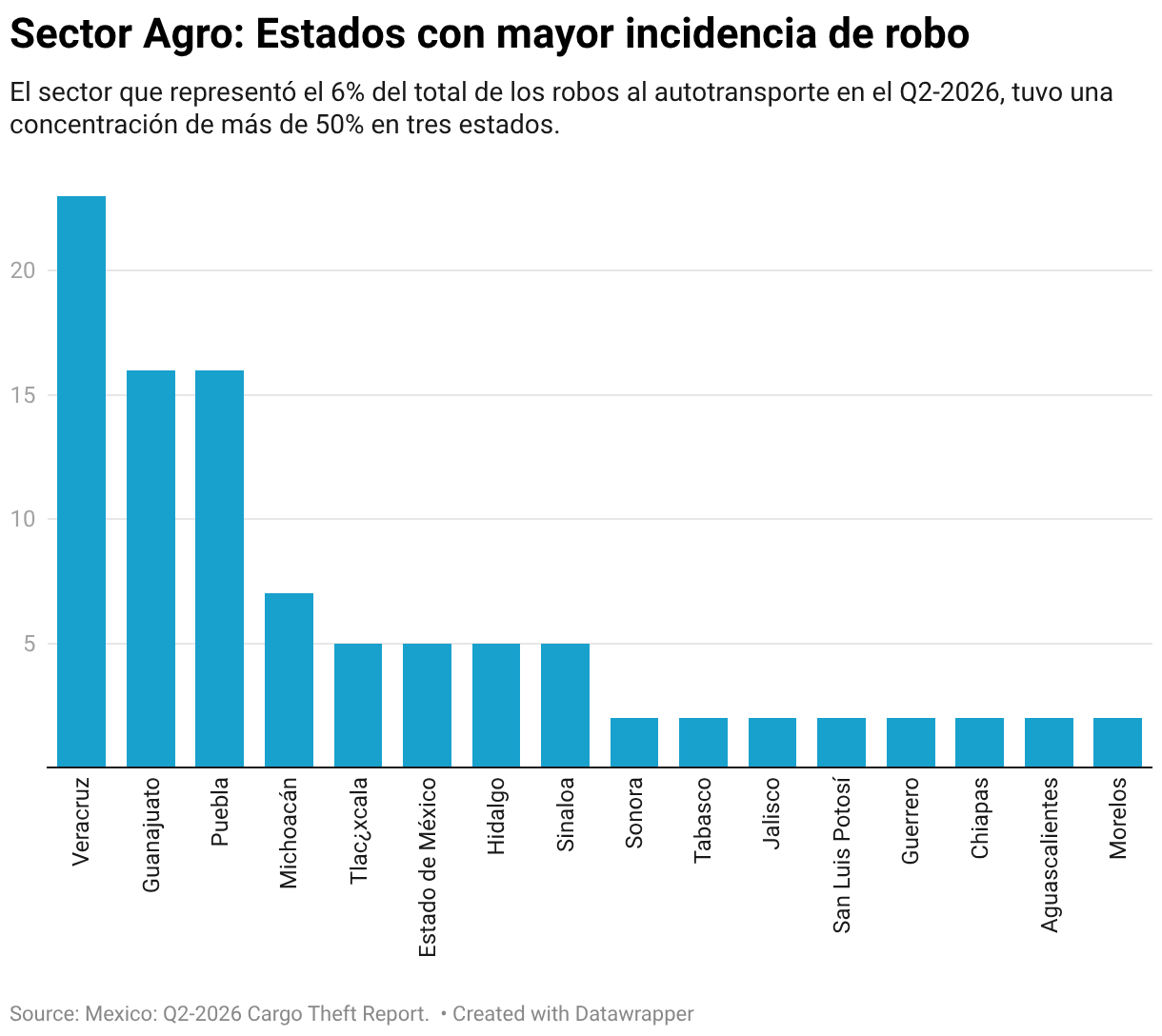
During the May-September period, agricultural theft tends to increase due to higher demand in the sector. In Q2 2026, the risk level for this industry grew by 4 percentage points compared to the previous year , representing 6% of thefts nationwide.
Thefts of agricultural products were geographically concentrated in the central region, where 38% of the cases occurred , the southeast with 33% and the Bajío with 21%.
Five states accounted for 75% of the total theft: Veracruz 25%, Puebla 25%, Michoacán 8%, Hidalgo 8% and Guanajuato 8 percent.
Regarding the roads with the highest risk for the agricultural sector, the MEX-150D (Mexico-Veracruz) stood out with 16% of the incidents, MEX-45D (Queretaro-Leon) with 8%, MEX-140D (Amozoc-Perote) with 8%, MEX-145D (La Tinaja-Minatitlan) also with 8%, MEX-15D (Atlacomulco-Zapotlanejo) at 8 percent.
Comment and follow us on LinkedIn: @GrupoT21