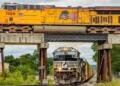
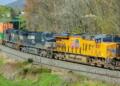
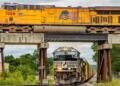
Union Pacific (UP) and Norfolk Southern (NS) reported that they submitted new information requested by the Land Transportation Board (STB ) regarding customer protection; however , the authority requested that the companies make certain employee data public.
The STB clarified that on May 28th it suspended the UP-NS merger process pending a new order and requested additional information from the applicants. In that decision, the Board stated that the suspension did not affect the discovery phase.
He explained that on July 2 , several unions filed a joint motion asking him to order the companies to reclassify as “public” the employee impact annexes included in the appendices of the revised application, arguing that they had improperly designated the information as “highly confidential.”
These annexes provide detailed information on how the proposed merger would affect UP and NS trades and management employees , including the number of posts that would be abolished, created, or designated as transferred due to the proposed merger, and the post transfer locations for certain posts.
“In its decision, the Board granted the unions’ motion, concluding that this type of information has been publicly disclosed in prior proceedings and does not appear to be commercially or competitively sensitive. Applicants must reclassify the employee impact annexes as public and submit those documents to the Board by July 27. It also notes its commitment to ensuring that its proceedings remain open to meaningful participation from all interested parties, and applicants may take this opportunity to address, as appropriate, any concerns about public participation as part of their supplemental responses,” the statement said.
Meanwhile, UP stated that it offered better customer protections than any previous rail merger. The new commitments are provided along with the additional information requested by the STB.
“The merger will provide our customers with faster, more reliable, and more efficient coast-to-coast service from day one and will generate savings that will be passed on to consumers. We speak with our customers every day, and by listening to them and reviewing STB feedback, we saw opportunities to offer additional assurances through an unprecedented set of voluntary commitments to our customers,” said Jim Vena, CEO of UP.
Among the new commitments are new competitive opportunities. The combined rail will significantly expand the Gateside Price Commitment (GPC), doubling the number of eligible shipments and extending the benefits to rail bulk carriers.
Similarly, railroads will preserve Class I for three to two shippers, as well as for two to one shippers, where they may legally grant access to another railroad.
Likewise, in the event that service performance decreases during the merger integration, customers will be able to obtain temporary access to an alternative rail service.
Regarding the public benefits of the merger that are not delivered on time, customers will have access to a new pricing process. Combined with the new service protection during the integration period, this new process places greater responsibility on customers.
“The public benefits of our merger are clear. A stronger supply chain makes American businesses more competitive. Shifting freight from road to rail reduces wear and tear on taxpayer-funded highways, improves safety, eases congestion, and lowers emissions. Revitalizing the rail industry creates well-paying, unionized jobs,” said Mark George, president and CEO of Norfolk Southern.
Comment and follow us on LinkedIn: @GrupoT21