The awarding of the Made in Mexico distinction to 11 companies affiliated with the Mexican Association of Shipping Agents (Amanac) came with a message that went beyond business recognition: the federal government admits that, in order to fully take advantage of the economic opportunity before it, Mexico must resolve historical shortcomings in infrastructure, security, training and formalization.
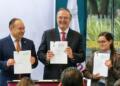
The companies recognized by the Ministry of Economy (SE) were Agencia Naviera de México, Sea Alliance, Samsung SDS México, Kundiso, Ceci, Fisa, Semave, CICE O+C, Ascop, Navieros y Consignaciones and CICE , companies linked to foreign trade and maritime logistics that joined one of the strategies promoted within the so-called Mexico Plan.


During the ceremony, Ignacio Aguado, Director General of Innovation, Services and Domestic Trade at the Ministry of Economy, stated that the certification aims to strengthen national content and increase the country’s competitiveness in an international environment marked by trade tensions, reconfiguration of supply chains and growing competition among emerging economies.
However, the official also acknowledged that Mexico faces challenges that limit its ability to fully capitalize on its strategic position. “ Infrastructure is one of them; we still have a lot to resolve regarding security —it’s the number one demand,” he stated, noting that industrial and logistical growth has outpaced the country’s capacity to develop the necessary conditions to sustain it.
The message is particularly relevant for a sector that depends on the efficiency of ports, roads, customs, and supply chains . While the government promotes greater production integration and a strengthening of domestic content, the authority itself acknowledges that bottlenecks persist that can affect the competitiveness of companies operating in foreign trade.
Aguado defended the government’s strategy, asserting that Mexico retains advantages that are difficult for other countries to replicate, especially due to its integration with the United States. “We are irreplaceable ,” he stated, referring to the trade relationship between the two nations and the role of the United States-Mexico-Canada Agreement (USMCA) within the regional economy.
Another point that drew attention was the recognition of the shortage of specialized talent facing the logistics industry . The official explained that the Ministry of Economy is promoting training and certification programs to professionalize the sector, given the growing demand for qualified personnel.
Business formalization also emerged as one of the most significant outstanding issues. Aguado pointed out that more than half of the country’s economic units operate informally , a condition that limits productivity, competitiveness, and the economy’s growth potential.
In this context, the Made in Mexico label seeks to become more than just a promotional seal. “We have a roadmap, we have a strategy, and one of those strategies is the Made in Mexico certification ,” stated the official, who defended the initiative as a tool to identify formal businesses, raise standards, and strengthen the presence of national suppliers and service providers.
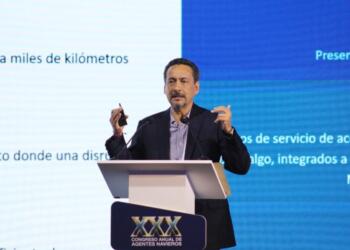
On behalf of Amanac, Roberto Meillón emphasized that the association decided to join the program from the outset. “We didn’t hesitate for a second; it was something that clicked immediately ,” he stated. The organization’s president noted that the member companies share an interest in contributing to the country’s economic development and expanding the value they offer their customers.
The awarding of the distinction thus left a dual interpretation: on the one hand, the government’s commitment to strengthening the domestic market and national supply chains; on the other, the recognition that Mexico’s competitiveness will continue to depend on its ability to solve structural problems that the government itself identifies as pending.
Comment and follow us on LinkedIn: @Enrique Duarte Rionda / @GrupoT21