Despite the expected increase in electricity demand during the World Cup, which will be held from June 11 to July 19 in Mexico, the United States, and Canada, the Mexico City government guaranteed that there will be no interruptions in the Light Rail and Trolleybus transportation services. during this sporting event.
Martín López Delgado, general director of the Electric Transportation Service of Mexico City , said that there are seven sub-electric units that will be connected to each other to guarantee energy.
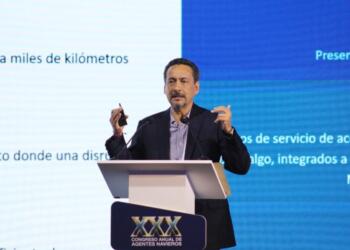
“We connect one substation to another so that if one of them fails, the section that stops being fed will be supplied by the adjacent electrical substation to ensure that the electrical line will have a power supply without major problems,” he said during the webinar “ World Cup Mobility: CDMX Light Rail” , organized by the Mexican Association of Railways (AMF) .
According to an article by the Mexican Institute of Finance Executives (IMEF) , demand in the National Electric System will experience increases of between 3% and 10% during the World Cup. , due to the simultaneous switching on of millions of televisions.
While the Light Rail consumes approximately 507,212 kWh (kilowatt-hours) per month , according to the Mexico City transparency portal, each average run on the entire line (Tasqueña–Xochimilco) requires around 36,229 kWh.
López Delgado recalled that during the last two six-year terms, an investment of three billion 690 million pesos (mdp) was made in the nation’s capital for different maintenance and infrastructure works for this transport system .
“This has allowed us to reduce travel times and increase operating speed, leading to savings of 26% in travel time, which in turn allowed us to operate the line with greater safety, regularity, and service frequency,” he emphasized.
Currently, the Light Rail has 34 trains with a capacity of 750 passengers each , and from Tasqueña to Xochimilco it has a journey time of 35 minutes with intervals of between four and five minutes, and a cost of three pesos.
Martín López commented that the fleet was modernized, as it previously had 35-year-old units, and with this new capacity it is expected to transport 200,000 users per day, compared to 90,000 before .
He explained that the Tasqueña station was renovated to accommodate coupled trains, allowing passengers to board and disembark simultaneously using two trains at the station. It also has a direct connection to Trolleybus Line 12, which runs from Tasqueña to Periférico.
The city official explained that a regulation system was acquired that will guarantee service, train frequencies, and safety for users; in addition, the proximity of trains will be reported, among other things.
“It is a system that we are in the process of implementing and that will be partially operational for the 2026 World Cup in terms of train communication and location. This will give us a guarantee of security to provide a quality service to everyday users, but above all to those attending the five matches that will be held in the Mexico City stadium,” he noted.
He stated that they expect 30,000 users to attend the matches, so the challenge will be to maintain the service at between four and five minutes in the face of increased demand, and to ensure the journey from Tasqueña to the stadium in just 15 minutes .
He also indicated that upon the departure of the attendees, there will be special units to provide service from the Estadio Azteca station to Tasqueña.
López Delgado noted that during the five matches to be held in Mexico City, they will also implement special services using 150 electric trolleybuses , which are expected to transport an additional 20,000 users.
“We are going to implement special services so that people can travel from their homes, hotel zones, and tourist areas to get to the stadium. We are going to become an alternative to make things easier for attendees,” he emphasized.

In addition to these two modes of transport, he said that the Metro, Metrobús and some concessionaires will cater to the demand of those attending the World Cup in various points of the nation’s capital.
With these actions, the Mexico City government seeks to guarantee the service of the Light Rail, a transportation system that has recently experienced failures, such as on June 2, when it operated provisionally from Tasqueña to Estadio Azteca, after a branch fell on the catenary in the Huipulco-Xomali station.
Comment and follow us on LinkedIn: @Evangelina del Toro / @GrupoT21