LIMA, Peru.- Located approximately 80 kilometers north of the Peruvian capital, the new port of Chancay , a majority investment by the Chinese company Cosco Shipping , has begun operations with the ambition of becoming the most important logistics hub in the South Pacific of Latin America . Its modern infrastructure, automated design, and direct connection to Asia position this terminal as a key point for regional foreign trade, taking into account the importance that China has acquired for Latin American countries.
With an initial investment of over $1.3 billion, the project began operations in June 2025. It currently handles between 13 and 14 ships per week. It has a capacity to handle one million TEUs (20-foot containers) annually , a figure that will expand to 1.5 million with the addition of six new ARMG cranes (fully automated) by 2026.
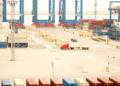
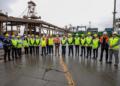
T21 was present at the Port of Chancay, invited by AAPA LATAM , as part of its 2025 Congress, held in Lima, Peru, at the end of last June. The port complex has four docks: the first two for bulk cargo, rolling cargo, and industrial projects, and docks 3 and 4, with 860 meters of berthing line, designed for containers and operated with a fully robotic system. The terminal has the capacity to receive vessels up to 400 meters in length and 24,000 TEUs.
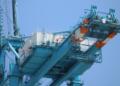
On the sustainable front, the Port of Chancay has been developed with a 100% electric approach . It has 15 ARMG cranes, six STS cranes, 40 autonomous vehicles, and a network of charging stations distributed throughout the terminal. Its energy consumption of 33 megawatts is supplied from a proprietary substation with an installed capacity of 50 megawatts, projected to 150 megawatts. Internal communications operate via the 5G network, eliminating dependence on conventional radios.
One of the key elements of the project is its underground logistics tunnel, which connects the entry area with the operational area, enabling efficient and safe transit. At this point, each unit undergoes automated inspections and mandatory customs scanning. Starting in November 2025, 100% of cargo will be inspected with high-end scanners donated by U.S. Customs.


Comment and follow us on X: @EnriqueDuRio / @GrupoT21