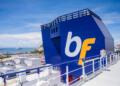
Throughout its 23-year history, Baja Ferries has maintained a dynamic of modernizing its fleet that has led it to replace its vessels in an average of 18 months , as Nino Liaño , the company’s general director, stated to T21 before the end of 2024 .
A new ship will begin service in mid-July , thus maintaining its dynamic approach of renewing its vessels every 18 months. This ship will replace the Mexico Star, which will no longer be part of its fleet. This will allow it to increase its capacity on the Mazatlán–Pichilingue (La Paz) route .
“It’s a ship that boasts cutting-edge technology. We’ve invested in the technical side to maintain our value proposition, which is based on safety, schedule adherence, and service,” Nino Liaño told T21.

According to the executive, the incorporation of this vessel will allow them to continue supporting their business logic in three pillars .
“First, it will give us the opportunity to continue supplying Baja California with an incremental capacity of 1,000 more units per month, which is 12 linear kilometers to supply,” Liaño explained.
Secondly, by incorporating a new, efficient vessel , “it aligns with our value proposition of reducing emissions. We are making progress in generating 65% fewer emissions based on our 2017 record, and our goal is to reach 70% by 2030,” he stated.
It will also strengthen Baja Ferries’ tourism offering , both for passengers and operators.
With this vessel, which is a sister ship to the California Star that provides services between Topolobampo and Pichilingue, Baja Ferries will be able to standardize its value proposition on both routes , with differentiated services. In the case of Mazatlán, the route is covered in 13 hours, while in Topolobampo it is done in eight hours.
Based on what Nino Liaño described, the arrival of the new vessel will strengthen its service offering, which begins with boarding at the port of origin and will serve to boost connectivity with Baja California Sur.
Regarding cargo capacity, Nino Liaño anticipated that it will evolve according to market needs, for which the new customer experience area will allow for increased service levels, such as boarding and disembarking, which will be improved by 70% compared to the time required on the previous vessel, the Mexico Star.
Comment and follow us on X: @DidierRT / @GrupoT21