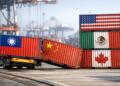
The World Trade Organization (WTO) estimated that global merchandise trade will grow by 2.4% in 2025 —driven by the frontloading of imports into the United States ahead of tariff increases—which is an encouraging figure compared to the 0.9% it had projected last August, although the outlook for 2026 indicates a decline.

According to the analysis, trade volume grew 4.9% year-over-year, while the dollar value increased 6% , which was an improvement over the WTO’s forecast. The digital value chain, from silicon to AI devices, was a key factor in this expansion.
“Countries’ measured response to tariff changes in general, the growth potential of AI, and increased trade with the rest of the world, particularly among emerging economies, helped mitigate trade setbacks in 2025,” said WTO Director-General Ngozi Okonjo-Iweala.
AI-related goods, such as semiconductors, servers, and telecommunications equipment, accounted for nearly half of trade growth in the first half of the year , with a 20% year-over-year increase in value. South-South trade also showed dynamism, growing 8% year-over-year and up to 9% between partners other than China.
Outlook for 2026
Despite improved projections for this year, the outlook for 2026 is less encouraging, as the delayed impact of tariff increases, reduced inventories, and greater political and trade uncertainty could lead to a slowdown.
Global merchandise trade volume growth is expected to contract to 0.5% in 2026. Global gross domestic product (GDP) growth is estimated at 2.7% for 2025 and 2.6% for the following year.
The WTO estimates that Europe will lead growth in services exports in 2025, followed by Asia and the Middle East, while North America will show a moderate performance. In 2026, Asia and Africa are expected to accelerate their services exports , while other regions will face a slowdown or stagnation.
The European Union recently announced it will double its steel tariff from 25% to 50% to safeguard its steel mills and jobs; it will also halve the tariff-free steel quota to combat Chinese competition, which is considered unfair.
The WTO projections come amid uncertainty in global trade, driven by the United States’ tariff policy, which has affected the flow of global merchandise trade.
Comment and follow us on X: @GrupoT21