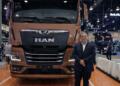
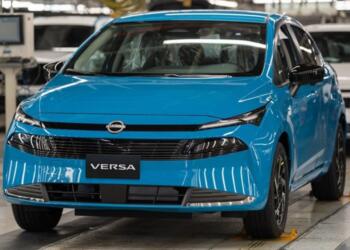
QUERÉTARO, QRO.- The story began before even stepping onto the production line. From the moment you entered, you could sense that something had changed: the renovated architecture, the meticulously cleaned and integrated aisles, and the coordinated movement of employees set the pace for a company that decided to reorganize its operations from within . Volkswagen Truck & Bus Mexico and MAN didn’t just want to showcase their plant; they wanted to convey the meaning behind every step taken in 2025 and the path they’ve charted for 2026.
The first part of the tour led to a building where teams, previously scattered, now work just a few meters apart. The decision to relocate after-sales service within the same complex wasn’t a logistical adjustment but a strategic move: to bring together in one space those who ensure a truck remains operational. The team explained it this way: “ After-sales is the heart of the plant ,” a simple phrase that encapsulates the ideology behind the renovations.
In that environment, another intention was revealed: to improve accessibility. The new connections between levels allow any employee to participate in meetings or training sessions without having to take alternative routes. This inclusion was described as one of the most significant moments of the recent process.
After that introduction, the door opened to the area that supports the production operation. The reorganized plant demonstrated a more agile assembly process than in previous years. The 10 stations and the pre-assembly stage now operate with electronic controls that record every torque applied and every step of the process, generating complete traceability linked to the VIN (a unique number assigned to each vehicle at the time of manufacture). This information is archived to answer any future after-sales questions, a practice that reflects the obsession with detail that was repeated throughout the tour.
Capacity remains at 2,300 units per year , a figure that aligns with a market still recovering after the technological shift from Euro 5 to Euro 6. This transition required a redesign of the plant’s interior, including moving areas, expanding spaces, and receiving parts and kits under a reorganized system that now integrates logistics and production within a few meters of each other.


Previously, the after-sales area occupied part of the production space; moving it to the new offices created an opportunity to expand the line, rearrange flows, improve times and prepare the site for new models.
The assembly sequence revealed a discipline that contrasted sharply with the silence on the floor. Cabs and engines arrive pre-assembled from Brazil, while nearly 400 parts are distributed daily according to the production schedule. Each station receives only what it needs and in the precise order to avoid errors. The SKD system dictates the operating method: Mexico assembles, integrates, adjusts, and validates the final components that will give life to Delivery, Constellation, and Huracán trucks, as well as buses like the 15.210 and the Volksbus 8.230.
There’s a unique feature at the plant: “Here in Querétaro, engine assembly is handled exclusively by women , a unique case within the Volkswagen Group. They explained that their performance, attention to detail, and consistency in assisted operations have made this station a hallmark of the plant, and that they have been in charge of this operation for two years now, following a specialized training process,” said Halley Vieira, head of production and logistics at the plant.
From there, the line begins to raise chassis, assemble suspensions, adjust harnesses, and connect electronic systems. Quality control starts at station one and continues to the last point of the production process. There is also a dedicated electronic network solely for production, where all critical operations and torques, especially those related to safety, are recorded.
Production shutdown gives way to the testing phase. There, in a secluded area, newly completed units are inspected. The atmosphere changes: specialist technicians appear, illuminated stations for detecting faults, and rework zones where every detail, from paint to internal connections, is corrected under supervision. The quality team explained that each unit travels eight kilometers (km) around the plant to detect functional defects.
This requirement is the foundation of a larger transformation: the development of the after-sales service that Volkswagen Truck & Bus aims to consolidate in Mexico. And that’s where one of the day’s key elements comes in: the Parts Logistics Center , also located in Querétaro.


The brand decided to relocate its entire parts business (previously operated from Puebla) to assume full control of inventory, lead times, supply, and distribution. The expansion, which added more than 5,000 square meters (m²) of space , quadrupled the staff and increased capacity from 150 lines per day to 800 , explained Juan Hernández, the brand’s After-Sales Executive Manager.
From this center, materials are shipped to 190 points of sale across the country, and today they can deliver stock orders within 48 hours in major cities , in addition to responding to emergencies in less than 24 hours . This operational leap has raised the service level to 93% , a figure that sets a competitive standard in the heavy vehicle market.
During the presentation, the Director of Operations, Rafael Santos Magalhães, emphasized: “ Many people say they put the customer at the center… we demonstrate it with facts.”
The tour also provided an opportunity to learn about Volks Care, the program that encompasses telematics, maintenance contracts, warranties, 24/7 assistance, training, and digital tools such as the checklist , which now allows customers to view the complete history of their vehicle since delivery. Each pillar of this system addresses an identified need: monitoring, preventing failures, acting quickly, and maintaining customer trust when their truck is out of service .
The intentions for 2026 were stated clearly. Giovanni Juárez, Director of Sales, Marketing, and After-Sales, explained that they are committed to a stronger, more professional dealer network, capable of meeting the standards demanded by the new models . They also want a more robust after-sales service, supported by complete parts control and the digitization of processes.
They explained that having autonomy in parts is not just an operational issue, but a strategic one: without spare parts there is no availability, and without availability there is no business for any freight customer.
Comment and follow us on X: @karinaquintero / @GrupoT21