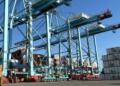
Although intermodal transport is growing, various infrastructure and process actions are needed to increase cargo movement, for example, from 25% to 80% in the ports of Manzanillo and Lázaro Cárdenas alone .
Víctor Monroy Vollmer, general manager for Mexico and Central America at Mediterranean Shipping Company (MSC) , stated that the country has the potential to be a regional intermodal hub or node , but “it remains untapped, far from what it could be. It’s important to have a strategy for the proper development of the rail network.”
At the 22nd edition of ExpoRail, organized by the Mexican Association of Railways (AMF) , he considered that the routes should be expanded to other areas and not just to the center of the country or to Guadalajara or Monterrey, “we need them to be towards the northwest and south.”
However, the executive indicated that there are three challenges for intermodal: the structural imbalance in import and export corridors , “this often prevents us from designing better service structures. We have important industrial hubs that bring in a lot of imports, but most of the exports go to the United States.”
Another challenge identified was the limited port infrastructure, automation, and customs , security, import, and export processes, which are inefficient, necessitating modernization, technological advancement, and digitization.
He also mentioned that the lack of operators in the trucking industry should be a factor in shifting more freight to rail, “however, we have a shortage of transportation, operators, and an industry deeply rooted in road transport.”
He indicated that Mexico is an important hub for the shipping company, as it connects cargo from the Atlantic and Pacific oceans, which are loaded onto north-south routes or to South America.
“ For us, intermodal makes a lot of sense , not only for operational efficiency but also for environmental efficiency. We are also promoters of decarbonization in partnership with railway companies in Europe, North America, Asia, and Mexico. We are strongly pushing the intermodal connection of our freight network. Mexico is an important center for freight acquisition and a logistics hub for our container distribution, so the intermodal option for moving full containers is important, but for moving empty containers, it is even more so,” he explained.
For his part, Rodrigo Estrada, CEO of Canadian National (CN) , reiterated that the challenges are infrastructure, but also political will and industrial concentration , and from this perspective, the company sees great potential for intermodal growth in the Bajío region, where 90% of companies from Quebec are concentrated.
“Indeed, intermodal terminals in the region have been growing, and I believe they are capable and, in some ways, well-suited for growth. But we do see some challenges. We need to review and probably adapt to current legislation and regulations. Today, laws do not favor intermodal transport over road transport. This causes customers to feel a certain degree of uncertainty, and the other is a cultural change, such as making the customer feel confident in approving a service. I can add a third factor: coordination between the different logistics operators, customers, and authorities. There’s a significant challenge there,” he said.
John Sánchez, commercial director of APM Terminals Lázaro Cárdenas , said that intermodal is a fundamental part, a strategic link in logistics for all of its clients , and even more so because of the railway infrastructure to which they have access, but he assured that it is essential that the actors in the chain share a vision of efficiency and competitiveness.
“Infrastructure, technology, since a well-structured process is an incredible foundation for automation, and digitalization is the easiest way to achieve intermodal, this is where the challenge lies,” he explained during his participation in the panel Freight Railways, Modal Shift, Challenges and Opportunities for Converting Freight to Intermodal .
He stated that this mode of transport has the potential to grow at the percentages mentioned in the ports of Manzanillo or Lázaro Cárdenas. At the start of operations in the latter, through the container terminal, it was estimated that it would be 80% intermodal versus 20% road, but currently the opposite is true, with an opportunity for growth for intermodal through nearshoring (relocation of production lines), industrial corridors, and companies’ sustainability agendas.
Diego Anchustegui, president of the Mexican Intermodal Transport Association (AMTI) , noted that the benefits of this service include price, transit time, sustainability, safety, and capacity. Meanwhile, on the maritime side, at the aforementioned ports, it is more competitive compared to road service.
“Intermodal has grown at an astonishing rate. We’ve seen double-digit cross-border growth this year. The macroeconomic situation is complicated, but intra-Mexico has increased in recent years. Maritime traffic has grown, and services have improved significantly, but we also have much to do,” he emphasized.
Comment and follow us on X: @evandeltoro / @GrupoT21